
Why Class B Fire Extinguishers Matter More Than You Think
In many Saudi workplaces, fire risk does not come from paper, wood, or fabric. It comes from fuel. From diesel stored for generators, solvents used in workshops, oils in mechanical rooms, and flammable liquids that are part of daily operations across industrial and commercial sites. This is where the class b fire extinguisher becomes critical, not as a checkbox item, but as a frontline tool in real emergency response.
A Class B fire extinguisher is designed specifically to combat flammable liquid fires, situations where using the wrong extinguishing agent can make the fire worse instead of better. In Saudi Arabia, where compliance expectations are high and operational downtime is costly, choosing the right extinguisher is as much a business decision as it is a safety one. From commercial fire safety in workshops to industrial fire protection in plants and fleet yards, understanding Class B extinguishers is essential.
This guide is written from a practical, on-ground perspective. Not theory for theory’s sake, but clarity for decision-makers, facility managers, and safety officers who need to protect people, assets, and continuity.
What Exactly Is a Class B Fire?
A Class B fire involves flammable liquids or gases that ignite and burn rapidly when exposed to heat or sparks. Unlike solid combustibles, these fires spread across surfaces, flow with gravity, and can re-ignite if not handled correctly. According to guidance aligned with international standards such as those published by the National Fire Protection Association, Class B fires behave differently and demand specific suppression methods.
In Saudi environments, these hazards are common. Fuel storage rooms, vehicle maintenance bays, paint storage areas, refuelling points, and even some warehouses regularly contain Class B fire risks. Treating these areas as “general risk” zones is a mistake that often shows up during inspections or, worse, during incidents.
Common Class B Fire Examples on Real Sites
On the ground, Class B fires typically involve gasoline, diesel, lubricating oils, solvents, paints, alcohol-based chemicals, and certain industrial fluids. These are not rare materials; they are part of daily operations in logistics, manufacturing, energy, and construction sectors across the Kingdom.
What makes these fires dangerous is not only their speed, but their tendency to re-flash once oxygen returns. This is why fire risk management for Class B hazards focuses on both extinguishment and vapour suppression, not just flame knockdown.
Liquids vs Gases: Clearing Up a Common Confusion
One of the most common questions in Saudi facilities is whether Class B covers gases as well as liquids. In practice, extinguisher classifications group flammable liquids and gases under the same category because the suppression principles are similar. The key difference lies in how the fuel behaves once ignition occurs.
Extinguisher labels simplify this by using clear symbols and extinguisher ratings, allowing a single unit to address multiple fire types. This is why many portable fire extinguishers in the Saudi market are multi-class, such as ABC-rated units, even though their performance on Class B fires differs by agent.
Understanding what is actually inside the extinguisher matters more than the letters on the label, which leads directly to the next critical question.
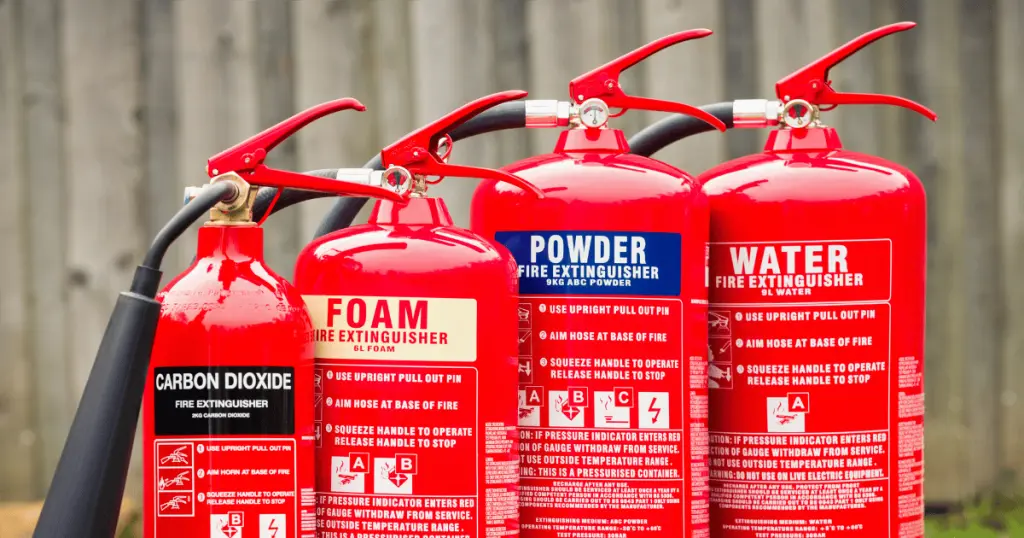
CO₂ vs Dry Chemical vs Foam: Which Class B Extinguisher Is Right?
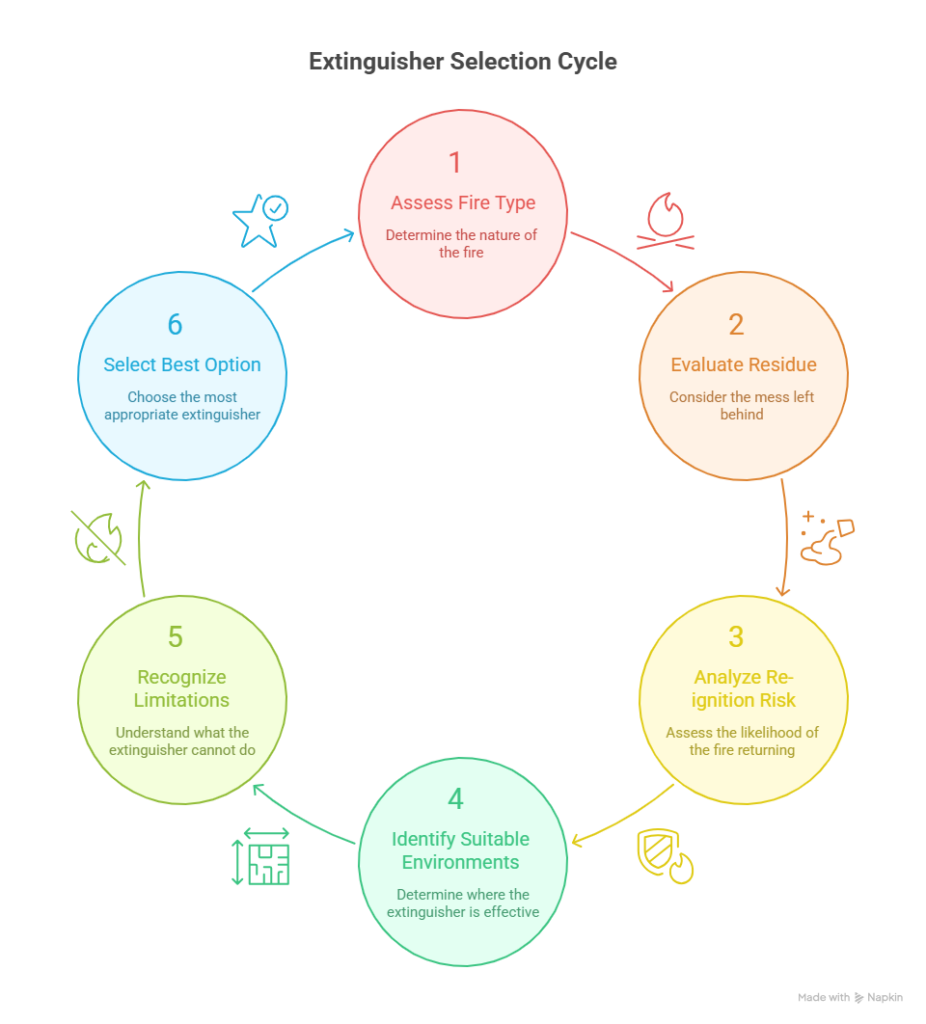
Choosing a Class B fire extinguisher is not about buying “the best” one universally. It is about matching the agent to the environment, the risk, and the consequences of discharge. This debate comes up constantly in safety meetings, procurement discussions, and even technical forums, for good reason.
CO₂ Extinguishers: Clean but Context-Specific
Carbon dioxide extinguishers are widely used in Saudi facilities where sensitive equipment is present. Control rooms, electrical substations, data centers, and laboratories often rely on CO₂ because it leaves no residue and does not damage electronics. Industry guidance and practical examples referenced in regional standards such as those discussed in Saudi-adapted safety documentation confirm this preference.
However, CO₂ works by displacing oxygen, not cooling the fuel. In flammable liquid fires, this means the fire can re-ignite once oxygen returns if the liquid surface remains hot. This limitation is well documented in professional discussions, including technical debates found on platforms like Home Improvement Stack Exchange.
CO₂ is effective, but only when applied correctly and in controlled spaces.
Dry Chemical Extinguishers: Fast Knockdown, Real Tradeoffs
Dry chemical extinguishers, particularly BC-rated units using agents like potassium bicarbonate, are common in industrial settings across Saudi Arabia. They are valued for their rapid flame knockdown and effectiveness against fuel-based fires, which is why they appear frequently in industrial fire protection strategies.
The tradeoff is residue. Powder discharge can damage machinery, contaminate products, and require extensive cleanup. For workshops and open industrial areas, this is often acceptable. For precision environments, it is not. These real-world tradeoffs are a recurring theme in practitioner discussions, including those highlighted in technical Q&A forums such as this analysis on extinguisher residue and equipment damage.
Foam Extinguishers: Vapour Control and Re-Ignition Protection
Foam extinguishers operate differently. Instead of just attacking flames, they create a blanket over the liquid surface, suppressing vapours and reducing the risk of re-ignition. This makes them particularly effective for larger liquid spill fires and open fuel hazards.
Foam-based solutions are increasingly discussed in professional guidance from sources like NFPA educational resources, especially as global conversations evolve around newer, more environmentally conscious foam formulations. In Saudi facilities with fuel storage or vehicle maintenance operations, foam can offer a strong balance between control and safety when properly specified.
Understanding Class B Ratings and What the Numbers Mean
One of the most misunderstood elements of a class b fire extinguisher is the number attached to its rating. These numbers are not marketing labels. They represent performance levels measured under controlled testing conditions, as defined by standards such as those maintained under NFPA 10.
A higher Class B rating generally indicates the extinguisher’s ability to handle a larger surface area of flammable liquid fire. However, this does not mean a higher number is always better for every site. Over-specifying can create unnecessary cost and handling challenges, while under-specifying creates obvious safety gaps.
In Saudi Arabia, experienced safety professionals often align extinguisher ratings with the size of the hazard zone, fuel load, and expected response time. This is where professional assessment matters more than generic purchasing.
Saudi Compliance Reality: What Buyers Actually Need to Check
While international standards shape fire safety globally, Saudi Arabia operates within its own regulatory ecosystem. Products commonly reference SASO conformity, third-party listings such as UL or FM, and alignment with Saudi Civil Defense expectations. Official guidance from bodies like the Saudi Standards, Metrology and Quality Organization plays a key role in procurement decisions.
In practice, inspectors and insurers look for consistency. Clear labelling, documented ratings, serviceability, and proper installation matter just as much as the extinguisher type itself. Fire safety equipment that cannot be serviced locally or lacks proper documentation often becomes a liability rather than a safeguard.
This is also where workplace fire safety intersects with training and inspection readiness, setting the stage for how extinguishers are placed, maintained, and used.
Placement, Accessibility, and Real-World Use of Class B Fire Extinguishers
Where Should Class B Fire Extinguishers Be Installed?
The guiding principle for placement is simple but often misunderstood. A Class B fire extinguisher should be close enough to a hazard to be reached quickly, but never so close that a person must approach the fire to access it. This balance is especially important for flammable liquid fires, which can spread rapidly and unpredictably.
In Saudi facilities, best practice places extinguishers at exits to high-risk areas such as fuel storage rooms, generator enclosures, workshops, and vehicle maintenance bays. This allows a person to fight the fire while keeping a clear escape route behind them. Guidance aligned with international practices referenced in professional safety documentation, including examples drawn from regional standards discussed in resources such as Saudi-adapted industrial safety references, consistently reinforces this logic.
What often causes issues during inspections is not the absence of extinguishers, but their poor positioning. Units hidden behind doors, blocked by pallets, or placed inside the hazard zone itself undermine the entire concept of fire risk management.
Mounting Height and Accessibility: Small Details, Big Consequences
Mounting height may seem like a minor technical detail, but it directly affects response time and usability. If an extinguisher is mounted too high, shorter users may struggle to remove it quickly. If it is mounted too low, it becomes vulnerable to damage, obstruction, or being overlooked entirely.
Industry guidance commonly referenced in the Saudi market follows a simple logic. Lighter portable fire extinguishers are mounted so the handle is easily reachable, while heavier units are positioned lower to reduce lifting strain. These principles appear consistently across international standards and practical interpretations used by contractors and safety officers in the Kingdom.
Accessibility also extends beyond height. Clear signage, unobstructed visibility, and consistent placement across a site reduce hesitation during emergencies. In real incidents, people do not search for extinguishers. They move toward where they expect them to be.
How Many Class B Extinguishers Are Enough?
This question is frequently asked by facility managers looking for a single number. In reality, there is no universal answer. The required quantity depends on travel distance, hazard size, and the nature of the flammable liquids present. Larger or more complex sites require a structured assessment rather than guesswork.
Standards referenced by organizations such as the National Fire Protection Association emphasize that extinguisher coverage is tied to hazard classification, not just floor area. In Saudi Arabia, this is often reinforced during Civil Defense reviews, where inspectors look at whether extinguisher distribution actually reflects site risks.
The practical takeaway is that extinguisher planning should follow a simple sequence. Identify where flammable liquids exist, understand how people move through those areas, and ensure no one has to travel an unsafe distance to reach an extinguisher during a developing fire.
Using a Class B Fire Extinguisher Correctly
Even with perfect placement, a Class B extinguisher is only effective if it is used properly. This is where training, even at a basic level, becomes non-negotiable. The most widely taught method for extinguisher use is the PASS technique, a framework promoted in educational guidance such as that published by the NFPA.
PASS stands for pull, aim, squeeze, and sweep, but for Class B fires, the technique requires additional awareness. The aim should be directed at the base or edge of the fire, not the flames themselves. Sweeping should move across the surface of the liquid, not through the air above it. This distinction is critical in flammable liquid fires, where surface vapours sustain combustion.
Equally important is knowing when not to use an extinguisher. If the fire is spreading rapidly, producing heavy smoke, or blocking the exit, attempting suppression can put lives at risk. Emergency response tools are meant to support safe evacuation, not replace it.
Why Some Class B Fires Re-Ignite After Extinguishment
One of the most frustrating scenarios reported by safety teams is a fire that appears to be out, only to re-ignite moments later. This is not always due to incorrect use. It is often a characteristic of the extinguishing agent itself.
CO₂ extinguishers, for example, remove oxygen but do not cool the fuel. Once the gas disperses, oxygen returns, and hot liquid can re-ignite. This behaviour is widely discussed in technical communities and practical forums, including detailed explanations found on Home Improvement Stack Exchange.
Foam and certain dry chemical agents reduce this risk by interrupting the chemical reaction or isolating the fuel surface. Understanding these dynamics is key when selecting extinguishers for high-risk zones, particularly in industrial fire protection settings where fuel loads are significant.
Inspection, Testing, and Maintenance: The Hidden Backbone of Fire Safety
A Class B fire extinguisher that is not inspected regularly is a false sense of security. Pressure loss, damaged hoses, missing pins, or expired agents are common issues discovered during routine checks. This is why inspection, testing, and maintenance programs, often referred to as ITM, are central to workplace fire safety.
Guidance aligned with NFPA practices, including detailed inspection principles outlined in resources such as the NFPA guide to extinguisher ITM, emphasizes consistency. Visual inspections should be frequent, while professional servicing follows a defined schedule.
In Saudi Arabia, documented maintenance carries additional weight. Inspection tags, service records, and clear identification of service providers are often reviewed during audits and insurance assessments. A well-maintained extinguisher demonstrates not only compliance, but operational discipline.
Choosing the Right Service Partner in Saudi Arabia
Maintenance is only as reliable as the company performing it. One of the most common operational challenges is sourcing extinguishers that meet standards but lack local service support. Without access to refills, parts, or certified technicians, even high-quality equipment becomes a liability.
Experienced facility managers prioritize suppliers who offer both fire safety equipment and long-term servicing. This approach aligns with the expectations of regulators and insurers alike and supports broader fire suppression systems planning across a site.
Consistency in servicing also supports training. When equipment is uniform and well-maintained, staff familiarity increases, reducing hesitation during emergencies.
Strategic Selection and Long-Term Fire Safety Planning with Class B Extinguishers
How do organizations choose the right mix of protection? How do extinguishers support broader fire suppression systems? And how can companies move beyond minimum requirements toward meaningful fire risk management?
Matching Class B Extinguishers to Industry-Specific Risks
Not all Saudi workplaces face the same fire risks, even when flammable liquids are present. A logistics warehouse storing packaged goods faces a different threat profile than a refinery workshop or a fleet maintenance facility. Strategic selection begins with understanding how, where, and how often fuels are used.
In commercial environments such as workshops, kitchens with fuel storage, or service centers, Class B extinguishers often serve as the primary emergency response tools. Here, ease of use, clear labelling, and fast access matter most. In contrast, industrial sites typically layer protection. Portable extinguishers act as the first response, backed by fixed systems, trained teams, and formal emergency procedures.
Saudi industrial practices, influenced by globally recognized standards and adapted local expectations, frequently combine CO₂ or dry chemical extinguishers with more comprehensive systems. This layered approach reflects the reality that no single device can manage all scenarios, especially where fuel volumes are high.
Integrating Portable Extinguishers with Larger Fire Suppression Systems
A common misconception is that portable extinguishers and fixed systems operate independently. In reality, they are designed to complement each other. Portable fire extinguishers provide immediate response in the critical early moments of a fire, while fixed systems take over if the incident escalates.
In facilities with fuel storage tanks, pump rooms, or generator enclosures, extinguishers are often positioned to allow trained staff to intervene before a fire grows large enough to trigger automated suppression. This integration reduces damage, limits downtime, and supports safer evacuations. Industry guidance, including interpretations aligned with standards discussed by the NFPA, consistently emphasizes this layered defence concept.
Training as the Missing Link in Workplace Fire Safety
Even the best-designed safety systems fail without trained people. In many Saudi workplaces, extinguisher training is treated as a formality rather than a practical skill. This creates a gap between compliance and capability.
Effective workplace fire safety training focuses less on memorizing rules and more on building confidence. Employees should understand what type of fire they are facing, which extinguisher to use, and when to step back. This is particularly important for Class B fires, where incorrect application can spread burning liquid or cause re-ignition.
Organizations that invest in regular, scenario-based training tend to see better outcomes during inspections and emergencies. Training also reinforces the purpose of inspections and maintenance, making fire safety a shared responsibility rather than a checklist owned by one department.
From Compliance to Culture: A Saudi Perspective
In Saudi Arabia, fire safety compliance often begins with documentation. Certificates, inspection tags, and approved equipment are essential, but they are not the end goal. The most resilient organizations treat compliance as a baseline, not a finish line.
This mindset shift is especially relevant for commercial fire safety and industrial fire protection, where operations evolve over time. New equipment, new materials, and changing workflows can introduce new Class B fire risks without obvious warning. Periodic reassessment ensures that extinguisher placement, type, and rating continue to match reality.
Authorities such as the Saudi Civil Defense emphasize readiness and preparedness, not just presence of equipment. This aligns with international thinking promoted by organizations like the NFPA, where fire safety is framed as an ongoing process rather than a static requirement.
Procurement Decisions That Support Long-Term Safety
One of the most overlooked aspects of fire safety is procurement strategy. Choosing a class b fire extinguisher based solely on initial cost often leads to higher expenses later. Limited service availability, incompatible refills, or unclear documentation can complicate inspections and disrupt operations.
Experienced safety managers in Saudi Arabia prioritize suppliers who understand local expectations and can support the full lifecycle of fire safety equipment. This includes installation guidance, maintenance support, training, and documentation. When extinguishers are easy to service and clearly documented, they become assets rather than administrative burdens.
Procurement decisions also influence standardization. Using consistent extinguisher types and layouts across sites improves familiarity, shortens response time, and simplifies training programs.
Making Class B Fire Extinguishers Part of Risk Management, Not Just Response
A mature fire safety strategy treats extinguishers as one component of broader fire risk management. This means identifying where flammable liquids are introduced, how they are stored, and how processes might change over time. Extinguishers are then positioned and selected to reflect those risks, not generic assumptions.
In practice, this often starts with a simple internal review. Mapping fuel-related activities, evaluating worst-case scenarios, and aligning extinguisher types to those findings can significantly improve readiness. This approach reduces reliance on last-minute reactions and supports a calmer, more controlled emergency response.
Final Takeaways and Practical Next Steps
Across Saudi workplaces, the role of the class b fire extinguisher is both simple and complex. Simple in its purpose, but complex in how it must be selected, placed, maintained, and supported to work when needed. From flammable liquid fires in workshops to sensitive environments where residue cannot be tolerated, there is no one-size-fits-all solution.
The most effective organizations focus on three priorities. First, they match extinguisher type and rating to real hazards, not assumptions. Second, they integrate extinguishers into a wider safety system that includes training and maintenance. Third, they treat compliance as the starting point for building a safety culture, not the final objective.
When approached this way, Class B extinguishers stop being wall-mounted equipment and become active tools in protecting people, assets, and operations. That is the difference between meeting requirements and achieving meaningful fire safety.