
Fire Extinguisher Stand: The Foundation of Safe, Compliant Fire Protection in Saudi Arabia
Why a Fire Extinguisher Stand Is More Than a Metal Accessory
In many facilities across Saudi Arabia, fire safety conversations focus heavily on the extinguisher itself: its type, capacity, and inspection date. What is often overlooked is the fire extinguisher stand, a component that quietly determines whether that extinguisher will be usable when seconds matter. From office buildings in Riyadh to industrial sites in the Eastern Province, proper placement and mounting directly affect response time, compliance, and overall workplace fire readiness.
A fire extinguisher stand is not a decorative holder. It is a regulated safety element governed by civil defense requirements, Saudi Building Code provisions, and international benchmarks such as NFPA 10. When installed correctly, it ensures visibility, accessibility, and protection against damage or tampering. When ignored or misused, it becomes one of the most common reasons facilities fail a fire safety inspection.
Understanding the Role of a Fire Extinguisher Stand
What a Fire Extinguisher Stand Actually Does
At its most basic level, a fire extinguisher stand secures the extinguisher at a designated height and location. In practice, its role is far broader. It ensures the extinguisher is immediately visible, reachable by adults of different heights, and protected from accidental movement or obstruction.
In commercial and industrial environments, extinguishers left on the floor are prone to being moved, hidden behind furniture, or damaged by equipment. A properly installed stand eliminates these risks while supporting safety equipment installation standards recognized by regulators and insurers alike.
Why Placement Matters in an Emergency
Fire emergencies unfold quickly. Any delay caused by searching for equipment, lifting it from an awkward position, or navigating obstacles increases risk. Fire extinguisher stands are designed to standardize access so that anyone, trained or not, can respond instinctively.
This is why Saudi Civil Defense guidelines emphasize not just the presence of extinguishers, but their mounting method and positioning. A compliant stand supports emergency response equipment readiness by ensuring consistency across facilities, floors, and zones.
Regulatory Context in Saudi Arabia
Saudi Civil Defense and SBC Alignment
In Saudi Arabia, fire extinguisher stands fall under broader fire safety compliance frameworks governed by Saudi Civil Defense and the Saudi Building Code (SBC 801). These frameworks define acceptable mounting heights, spacing intervals, and visibility requirements to ensure extinguishers are usable by the public and staff alike.
According to official guidance outlined in DARS’s fire extinguisher compliance overview, improperly mounted extinguishers are treated as non-compliant even if the extinguisher itself is certified. This distinction is critical for businesses that assume equipment alone is sufficient.
NFPA 10 and International Benchmarks
While local regulations take precedence, Saudi authorities frequently reference NFPA 10 as a technical baseline. NFPA 10 specifies maximum mounting heights, weight-based positioning rules, and the importance of brackets or stands that can withstand repeated use without loosening.
Facilities operating under international audits or multinational corporate standards are expected to align with both local civil defense requirements and global commercial safety standards, making the fire extinguisher stand a point of convergence between the two.
The Risk of Improper or Missing Stands
Common Compliance Failures
One of the most frequent findings during fire safety inspections is extinguishers placed directly on the floor, inside cabinets without proper brackets, or behind doors and equipment. These placements violate both accessibility and visibility rules, even when signage is present.
In high-traffic commercial spaces, inspectors also flag extinguishers that are technically mounted but blocked by furniture, displays, or temporary installations. The stand alone is not enough; its surrounding environment must remain clear at all times.
Operational and Financial Consequences
Non-compliance is not a theoretical issue. Facilities found in violation may face fines, delayed operating permits, or failed renewals during annual audits. More critically, improper mounting exposes organizations to liability if an incident occurs and equipment is deemed inaccessible.
In industrial fire safety contexts, where extinguishers may weigh 25 kg or more, the absence of a suitable floor stand or trolley increases the risk of injury during handling. This is why inspection standards highlighted by Arabian Tool emphasize the condition and stability of stands alongside the extinguisher itself.
Types of Fire Extinguisher Stands Used in Saudi Facilities
Wall-Mounted Brackets and Stands
Wall-mounted stands are the most common solution in offices, retail spaces, and public buildings. These stands typically hold extinguishers ranging from 4 to 12 kg and are installed at regulated heights to ensure ease of access.
Saudi Civil Defense guidelines require labeling in both Arabic and English, clear signage, and secure fixing into concrete or structural walls. In logistics and transportation sectors, specialized wall mounts are also used inside vehicles to maintain workplace fire readiness on the move.
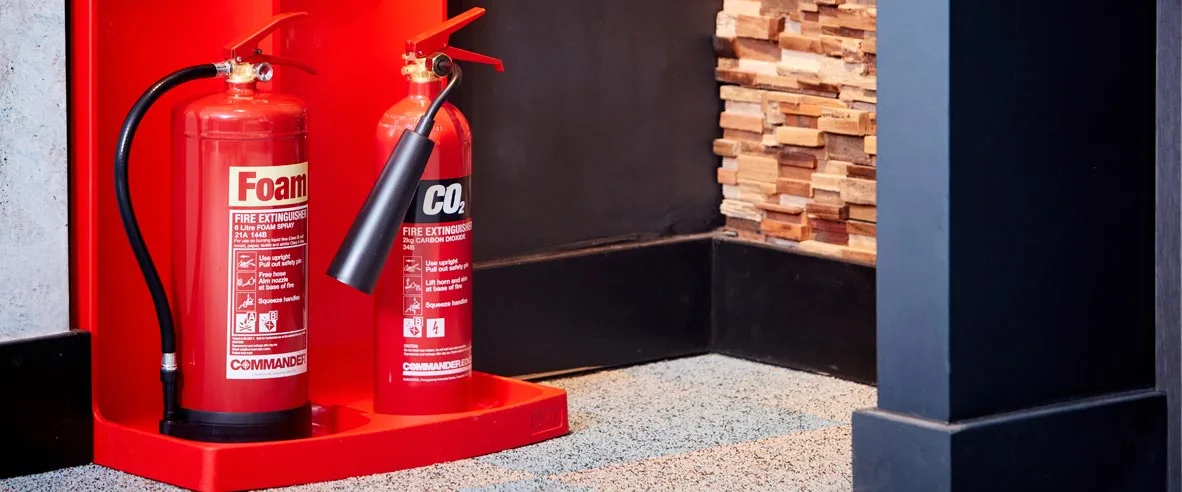
Floor Stands, Cabinets, and Trolleys
In warehouses, factories, and outdoor environments, floor-mounted stands and cabinets are preferred. These solutions accommodate heavier extinguishers and protect them from dust, humidity, and accidental impact.
Cabinets with transparent or break-glass fronts are commonly used in coastal cities like Jeddah, where environmental exposure can accelerate corrosion. Their use aligns with both fire hazard prevention and long-term asset protection strategies.
Visibility, Accessibility, and Human Factors
Designing for Real People, Not Just Codes
Regulations provide numbers, but effective safety design considers behavior. In an emergency, people do not read manuals; they follow visual cues and instinct. Fire extinguisher stands painted in high-visibility red, combined with overhead signage, significantly improve response time.
Facilities with low lighting, such as parking structures or industrial plants, increasingly integrate illuminated signage or photoluminescent markers. These enhancements support emergency response equipment effectiveness without altering core infrastructure.
Inclusion and Universal Access
Modern fire safety compliance also considers accessibility for people with disabilities. Clear floor space around stands, unobstructed reach ranges, and predictable placement paths contribute to inclusive safety design.
This approach is reinforced by guidance from national safety authorities and reflected in residential safety recommendations published by Saudi emergency services, which emphasize clear access paths in shared buildings.
Installation as Part of a Larger Fire Safety Strategy
Why Installation Quality Matters
Even the correct stand becomes a liability if installed poorly. Loose anchors, incorrect height measurements, or unsuitable wall materials compromise stability over time. Professional safety equipment installation ensures stands remain secure throughout daily use, cleaning cycles, and environmental stress.
DARS’s services emphasize integrated installation, where extinguisher placement, signage, and inspection schedules are treated as a single system rather than isolated tasks.
Linking Installation to Inspection and Maintenance
Fire extinguisher stands are inspected alongside extinguishers during routine fire safety inspections. Rust, bending, or loose fittings are grounds for replacement, not repair. This proactive approach prevents minor defects from escalating into compliance failures.
As facilities expand or layouts change, stands must be reassessed to maintain spacing and accessibility requirements. This is especially relevant in mixed-use developments where tenant fit-outs evolve over time.
Fire Extinguisher Stand Placement Rules in Saudi Arabia
From Theory to Site Reality
The next challenge facilities face is translating written standards into correct on-site placement. This is where many otherwise well-equipped buildings fall short. Compliance is not achieved by owning certified equipment alone, but by positioning it in a way that aligns with human behavior, inspection logic, and Saudi Civil Defense enforcement practices.
Placement rules exist to remove ambiguity during emergencies. They define where people instinctively look, how far they are expected to walk, and what physical effort is reasonable under stress. A correctly installed fire extinguisher stand creates consistency across floors and zones, reinforcing workplace fire readiness rather than relying on memory or training alone.
Height Regulations and Their Practical Purpose
Why Height Is Regulated, Not Optional
Saudi Civil Defense regulations specify maximum mounting heights to ensure extinguishers can be reached by most adults without strain. For wall-mounted fire extinguisher stands, the top of the extinguisher must not exceed approximately 1.5 meters from the finished floor level. This aligns closely with NFPA 10 guidance and international ergonomic standards.
The purpose of this rule is not bureaucratic. During a fire incident, lifting a heavy extinguisher from an elevated position slows response and increases the risk of dropping it. Conversely, placing extinguishers too low increases the likelihood of obstruction or damage. Height regulation balances accessibility with protection.
Weight-Based Height Considerations
Heavier extinguishers require additional consideration. Units exceeding common portable weights are often placed on floor stands or trolleys rather than wall brackets. This approach supports industrial fire safety environments where extinguishers may be used by staff wearing protective equipment or operating in confined spaces.
Inspectors assess whether the stand type matches the extinguisher’s weight and intended use. A mismatch, even if securely fixed, may still be flagged as non-compliant during a fire safety inspection.
Spacing, Coverage, and Response Time
Distance Rules and Why They Exist
Spacing requirements determine how far a person should travel to reach a fire extinguisher. In commercial and office settings, extinguishers are typically required every 15 to 30 meters, depending on occupancy type and hazard classification. Residential buildings follow area-based logic, often requiring one extinguisher per defined floor area.
These distances are calculated to keep response time within a critical window. Fire extinguisher stands play a key role by anchoring extinguishers at predictable intervals, preventing ad hoc relocation that disrupts coverage planning.
Placement Near Exits and Risk Zones
Extinguishers are commonly placed near exits, corridors, and transition points between zones. This positioning allows users to fight small fires while maintaining a clear escape path behind them. Fire extinguisher stands reinforce this logic by preventing extinguishers from drifting into corners, storage rooms, or behind doors.
In industrial facilities, additional stands are often required near high-risk areas such as electrical rooms, mechanical spaces, and loading docks. These placements support fire hazard prevention strategies specific to operational risk rather than generic layouts.
Visibility Standards and Human Behavior
Seeing the Equipment Before Needing It
Visibility is one of the most underestimated aspects of fire safety compliance. A fire extinguisher stand painted in red or finished with high-contrast materials ensures the extinguisher is recognizable even in unfamiliar environments. Signage above the stand reinforces visibility from a distance and across visual obstructions.
Saudi Civil Defense inspections assess visibility from normal walking paths, not from ideal angles. If an extinguisher cannot be seen clearly without searching, it is considered improperly placed regardless of technical compliance.
Low-Light and High-Density Environments
In parking structures, warehouses, and industrial plants, lighting conditions vary. Facilities increasingly incorporate illuminated signs or glow-in-the-dark markers to maintain visibility during power loss or smoke conditions. These measures strengthen emergency response equipment effectiveness without altering the core fire protection systems.
Such enhancements are particularly relevant in high-rise buildings and mixed-use developments, where evacuation routes and extinguisher access must remain clear under stress.
Fire Extinguisher Stands in Different Facility Types
Offices, Retail, and Public Buildings
In offices and malls, fire extinguisher stands must coexist with interior design, furniture, and customer flow. The most common compliance failures in these environments involve extinguishers hidden behind displays, counters, or decorative elements added after initial approval.
A compliant stand must remain unobstructed at all times, even during seasonal promotions or layout changes. This requires coordination between safety teams and facility management, not one-time installation.
Warehouses and Industrial Sites
Industrial environments introduce additional challenges. Dust, vibration, humidity, and equipment movement all affect stand durability. Floor stands and cabinets are often preferred, especially for larger extinguishers used in manufacturing and logistics operations.
According to industrial safety guidance referenced by Arabian Tool, stands in these environments must be inspected not only for positioning but for structural integrity. Bent frames or corroded fixings compromise both safety and compliance.
Installation Quality and Inspection Logic
What Inspectors Actually Look For
During a fire safety inspection, inspectors evaluate stands as part of a system. They check anchoring strength, alignment, signage, and whether the extinguisher can be removed smoothly without obstruction. A stand that technically meets height rules but wobbles or binds during removal may still be rejected.
This is why professional safety equipment installation is critical. Proper fixings, torque control, and wall material assessment ensure long-term stability rather than short-term approval.
Documentation and Traceability
Modern inspections increasingly emphasize documentation. Facilities are expected to demonstrate that stands were installed according to approved plans and maintained as part of routine safety checks. This aligns with broader commercial safety standards and risk management expectations.
DARS integrates installation records, inspection schedules, and corrective actions into a single compliance framework, reducing the risk of gaps during audits.
Common Placement Mistakes That Cause Audit Failures
Hidden, Obstructed, or Inaccessible Stands
One of the most frequent issues is extinguishers placed behind doors that swing open over them, or behind furniture added after installation. Even temporary obstructions can result in non-compliance if observed during inspection.
Another common mistake involves placing stands inside rooms rather than along circulation paths, forcing users to enter enclosed spaces during emergencies. Inspectors view this as a violation of basic fire safety principles.
Inconsistent Placement Across Floors
In multi-story buildings, inconsistency is a red flag. When extinguisher stands appear in different locations on each floor without clear logic, it undermines user familiarity. Regulations favor predictable placement patterns that support instinctive response.
Consistency is not just aesthetic; it is a functional requirement tied directly to workplace fire readiness and user behavior under stress.
Long-Term Management of Fire Extinguisher Stands
From Installation to Ongoing Responsibility
By this stage, it should be clear that compliance does not end once a fire extinguisher stand is installed and approved. In reality, that moment marks the beginning of an ongoing responsibility. Fire safety systems are living elements within a facility, affected by daily use, environmental conditions, renovations, and operational changes. Treating the stand as a static fixture is one of the most common strategic mistakes organizations make.
A mature fire safety approach views the fire extinguisher stand as part of a continuous lifecycle that includes inspection, maintenance, reassessment, and eventual replacement. This mindset is what separates facilities that pass audits consistently from those that rely on last-minute fixes.
Inspection Cycles and What They Really Measure
More Than a Visual Check
Routine fire safety inspections often focus on extinguisher pressure gauges and service tags, but inspectors also evaluate the condition and performance of the stand itself. They assess whether it remains securely fixed, correctly aligned, and free from corrosion or deformation. A stand that has loosened over time can fail an inspection even if the extinguisher is fully certified.
In Saudi Arabia, inspection logic increasingly reflects risk-based thinking. Inspectors consider whether the stand still performs its intended function under realistic conditions, not just whether it exists. This approach aligns with evolving fire safety inspection standards applied across commercial and industrial sectors.
Frequency and Environmental Factors
The required frequency of inspections depends on the environment. Office buildings may follow standard monthly visual checks, while industrial sites exposed to vibration, dust, or humidity require closer attention. Coastal locations, in particular, experience accelerated corrosion that can compromise metal stands faster than expected.
Facilities that document these checks and act proactively demonstrate stronger fire safety compliance and face fewer issues during official audits.
Maintenance, Repair, and Replacement Decisions
When Repair Is Not Enough
Not all damage can or should be repaired. Bent frames, cracked welds, or compromised anchor points are indicators that a stand has reached the end of its service life. Temporary fixes may restore appearance but do not restore structural integrity.
Industry best practice, reflected in guidance from safety equipment authorities, favors replacement over repair when a stand’s ability to hold the extinguisher securely is in doubt. This approach reduces long-term risk and supports consistent workplace fire readiness.
Matching Replacement to Current Standards
One overlooked issue is replacing stands like-for-like without reassessing current regulations. Standards evolve, and a stand that was compliant years ago may no longer meet updated civil defense requirements or visibility expectations.
Professional providers reassess height, spacing, signage, and accessibility during replacement, ensuring the new installation aligns with current fire protection systems rather than outdated layouts.
Managing Change Without Breaking Compliance
Renovations, Fit-Outs, and Layout Changes
Any change to a facility’s layout has the potential to disrupt fire safety planning. New partitions, furniture, machinery, or retail displays can unintentionally block access to fire extinguisher stands. This is especially common in commercial environments where layouts evolve frequently.
Effective fire hazard prevention requires that safety reviews are integrated into change management processes. Fire extinguisher stands should be reassessed whenever a space is reconfigured, not only during annual inspections.
Temporary Obstructions and Operational Habits
Even well-designed facilities can drift into non-compliance through daily habits. Storage placed “temporarily” in front of stands, equipment parked along corridors, or signage removed during maintenance all degrade readiness over time.
Organizations that embed fire safety awareness into operations, rather than treating it as a compliance exercise, maintain higher levels of emergency response equipment effectiveness.
Strategic Integration into Fire Safety Systems
Stands as Part of a Unified System
Fire extinguisher stands do not operate in isolation. They interact with signage, lighting, evacuation routes, alarms, and staff training. When these elements are designed and managed together, the result is a coherent system that supports quick, confident action during emergencies.
DARS’s integrated approach links stand placement and maintenance with broader fire protection systems, ensuring consistency across sites and simplifying audit preparation.
Documentation, Audits, and Risk Management
Modern compliance frameworks place increasing emphasis on traceability. Being able to demonstrate when stands were installed, inspected, and replaced strengthens an organization’s position during audits and incident investigations.
This documentation also supports internal risk management by highlighting recurring issues, high-risk zones, or environments where alternative solutions such as cabinets or trolleys may be more appropriate.
The Business Case for Doing It Right
Compliance, Reputation, and Continuity
While fire extinguisher stands may seem like a small detail, their impact extends beyond safety. Repeated compliance failures affect operating licenses, insurance terms, and brand reputation. In contrast, facilities that demonstrate consistent adherence to civil defense requirements build trust with regulators, tenants, and partners.
In sectors such as manufacturing, logistics, and retail, uninterrupted operations depend on predictable approvals and inspections. Properly managed stands contribute quietly but decisively to that stability.
Safety as a Leadership Signal
Organizations that invest in details signal a broader commitment to safety culture. Employees notice when equipment is accessible, maintained, and logically placed. This awareness reinforces training and encourages responsible behavior during emergencies.
From an external perspective, clients and auditors recognize professionalism in environments where safety elements are clearly planned rather than improvised.
Conclusion: The Quiet Importance of the Fire Extinguisher Stand
The fire extinguisher stand rarely attracts attention, yet it plays a decisive role in fire safety outcomes. It connects regulation with reality, design with behavior, and planning with action. When treated as an integral component of fire protection systems, it supports faster response, smoother inspections, and stronger compliance across Saudi facilities.
From correct placement and visibility to disciplined maintenance and strategic integration, the stand’s value lies in consistency. Organizations that understand this move beyond reactive compliance and toward sustainable safety management. In doing so, they reduce risk, protect people and assets, and meet the rising expectations of modern fire safety standards.