

A preventive maintenance procedure is one of those operational foundations that only gets attention when it’s missing. When equipment fails, operations slow, safety risks rise, and teams scramble to “fix what broke” instead of managing what matters. That’s why high-performing facilities and industrial sites treat preventive maintenance as a system, not a set of random tasks. Proactive maintenance reduces disruption and keeps performance stable, which is exactly the business outcome decision-makers care about.
In Saudi Arabia, the bar is even higher in many environments because maintenance often intersects with safety and compliance expectations, especially around fire protection and facility readiness. The General Directorate of Civil Defense publishes safety requirements and guidance that can influence how organizations document, inspect, and maintain critical systems. In other words, the “procedure” is not just about doing the work, it’s also about proving it was done correctly.
What Is a Preventive Maintenance Procedure?
A preventive maintenance procedure is a written, repeatable method for maintaining an asset before it fails. It defines what triggers the work, who does it, what steps must happen, what “pass” looks like, and what evidence must be captured when closing the job. Preventive maintenance is designed to prevent failures rather than react to them, which is a core distinction from breakdown or reactive maintenance.
In a well-run operation, the preventive maintenance procedure becomes the standard that protects consistency across technicians, shifts, and sites. That consistency is where results come from. It is also where accountability comes from, because everyone is following the same expectations.
Procedure vs Plan vs Checklist (Simple, Useful Definitions)
These three terms are often used interchangeably, but they serve different purposes.
The PM Plan
A plan is the program-level view. It defines the scope, coverage, goals, and cadence across assets, including an overall equipment maintenance schedule that aligns with staffing and downtime windows.
The PM Checklist
A checklist is the technician-facing execution tool. It is often a structured list of steps, inspection points, and acceptance criteria. This is where a preventive maintenance checklist belongs, especially when multiple technicians may perform the same job.
The Preventive Maintenance Procedure
The procedure connects the plan to execution. It tells the full story: triggers, safety steps, detailed tasks, tolerances, and required documentation. It is the backbone of a repeatable routine maintenance process.
Why Preventive Maintenance Procedures Matter (Especially in KSA)
When a preventive maintenance procedure is solid, performance improves quietly. Equipment stays available. Failures reduce. Budget becomes more predictable. The organization moves from firefighting to control, which is where operational maturity starts to show.
From a leadership perspective, the most immediate value is reducing equipment downtime. Downtime is not just repair cost, it is lost productivity, delayed service delivery, reputational impact, and safety exposure. That is why many organizations invest in preventive maintenance as a reliability lever rather than a “maintenance department task.”
In Saudi Arabia, documented maintenance can also support readiness expectations in facility environments, particularly where safety systems are involved. Civil Defense publishes fire protection and safety requirements, and organizations commonly mirror those expectations internally through documented checks, sign-offs, and retention practices.
If your site depends on regulated systems, your preventive maintenance procedure should be written like it may be reviewed. Because in practice, it often is.
What a Preventive Maintenance Procedure Should Include (Minimum Standard)
A strong procedure is not long for the sake of being long. It is complete in the places that prevent ambiguity, reduce risk, and make results measurable.
Asset Identity and Context
Start with clarity. Every procedure must point to a specific asset type and include how to identify it in the field.
Examples of fields that prevent confusion:
- Asset name and tag number
- Location and access notes
- Make, model, and any critical configuration details
- System role (what it supports and why it matters)
This is where you begin supporting asset lifecycle management, because you are creating traceable history per asset, not generic maintenance notes.
Trigger Logic (When the Procedure Runs)
Procedures need a clear trigger, otherwise they become either neglected or overused. Triggers typically fall into three categories:
- Time-based (every month, quarter, year)
- Usage-based (hours, cycles, distance)
- Condition-based (when indicators show decline)
This is one reason “predictive vs preventive maintenance” comes up so often. Preventive is triggered by time or usage, predictive is triggered by condition signals and data patterns. Many sites use both, but they must define when each applies to avoid confusion and wasted work.
Safety Requirements and Pre-Work Controls
A procedure should never assume the technician “already knows.” It should state the safety controls required to execute the task safely, especially where isolation, pressurization, or electrical risk exists.
If electrical inspections are part of your scope, note that standards and industry guidance increasingly emphasize inspection cadence and documented findings. That is one reason NFPA 70B discussions have become more visible in maintenance planning conversations.
Step-by-Step Tasks With Acceptance Criteria
The most common weakness in procedures is vague steps. “Check the pump” is not a step. A real step includes:
- What to check
- How to check it
- What the acceptable range is
- What action to take if outside limits
This is where maintenance best practices show up in a practical way. A best-practice procedure reduces judgment calls during execution, and saves judgment for the important moments like diagnosis, troubleshooting, and program optimization.
Close-Out Evidence and a Maintenance Documentation System
What gets documented becomes trackable, and what becomes trackable becomes improvable. Closing a work order should not be “done” and a signature. It should capture as-found and as-left condition, readings, photos where relevant, parts used, and notes that support future trend decisions.
A consistent maintenance documentation system is what transforms preventive maintenance from “tasks completed” into a reliability program with history. Documentation discipline is also central in professional guidance around inspections, including thermography, because the value is in traceability and comparison over time.
How to Build a Preventive Maintenance Procedure From Scratch (The Practical Way)
Many teams delay this because they think it requires a huge framework. It doesn’t. The smarter approach is to build your first set of procedures around critical assets and make the structure repeatable.
Step 1: Start With an Asset Register You Can Maintain
A preventive maintenance procedure can’t scale if asset data is messy. At minimum, your register should support:
- Unique asset IDs
- Clear location hierarchy
- Asset category (HVAC, pump, panel, fire pump, etc.)
- Criticality notes
If your register is clean, everything that follows becomes easier, from scheduling to reporting.
Step 2: Rank Assets by Criticality (So You Don’t Waste Effort)
Not every asset deserves the same intensity. Your team should focus first on the equipment that creates the biggest safety or operational impact when it fails.
A simple criticality method can score:
- Safety and compliance exposure
- Downtime cost and service impact
- Redundancy (single point of failure or not)
- Failure history frequency
The goal is not to be perfect. The goal is to choose the right starting list so your first procedures create visible impact.
Step 3: Build a Task Library (So You Don’t Rewrite Every Time)
Once you write a few strong procedures, you start noticing patterns: inspection tasks, lubrication tasks, cleaning tasks, calibration tasks, replacement cycles. That is where your “task library” begins.
This library becomes your reusable core for new procedures, and it supports a consistent maintenance planning strategy across assets. It also makes training easier because technicians learn the logic once, then apply it everywhere.
Step 4: Turn Procedures Into Work Orders and an Equipment Maintenance Schedule
A preventive maintenance procedure only creates value if it becomes an executed rhythm. That happens when procedures are converted into work orders and placed onto an equipment maintenance schedule that fits real operating constraints, including shutdown windows, shift patterns, and access requirements.
At this stage, many organizations implement a CMMS to manage triggers, templates, history, and reporting. But even if the system is basic, the structure should still be consistent, because your reporting quality will only ever be as strong as your input quality.
Where DARS Fits in the Picture
From a DARS perspective, preventive maintenance procedures should not live as isolated documents. They should connect to safety and operational objectives and remain easy to execute in the field. Organizations that treat procedures as living SOPs tend to see stronger compliance, clearer accountability, and better consistency across teams.
If your maintenance scope includes fire protection systems and facility safety requirements, it’s worth aligning your internal procedures with relevant local expectations and formal guidance from Civil Defense. You can also explore DARS’s approach and services through the Services page and learn more about real implementation outcomes through the Projects section.
Preventive Maintenance Procedure in Saudi Arabia: Execution, Frequency, and Documentation That Holds Up
How to Set the Right Preventive Maintenance Frequency
Frequency decisions are where most preventive maintenance programs either create value or quietly destroy it. Too little maintenance increases failure risk. Too much maintenance wastes labor, introduces human error, and inflates cost without reducing risk. A good preventive maintenance procedure must define frequency based on logic, not habit.
Start With OEM Guidance, Then Adjust to Reality
Most organizations begin with OEM manuals because they provide a defensible baseline. OEM recommendations are useful because they are designed around typical operating conditions and expected duty cycles. However, they are not tailored to how assets are actually used on site, especially in environments with harsh climate conditions or variable load patterns.
In Saudi Arabia, temperature, dust exposure, and continuous operation cycles often require adjustments. The preventive maintenance procedure should reflect this reality, not blindly copy manufacturer intervals. Industry discussions consistently emphasize OEM guidance as a starting point, not a finish line.
Time-Based, Usage-Based, and Condition-Based Triggers
A mature preventive maintenance procedure clearly states what triggers the work. Time-based triggers are common because they are easy to manage, but they can lead to over-maintenance if assets operate intermittently. Usage-based triggers are often more accurate for rotating equipment, vehicles, or systems with measurable cycles.
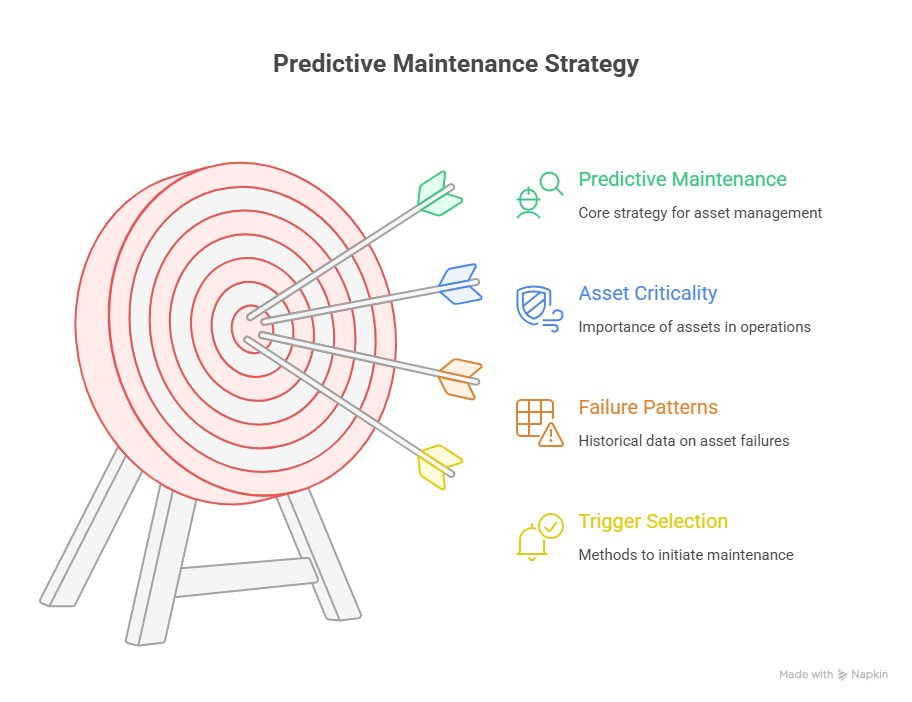
Condition-based triggers represent the bridge between preventive and predictive maintenance. This is where the discussion around predictive vs preventive maintenance becomes practical. Predictive methods such as thermography, vibration analysis, or oil sampling allow teams to act when indicators show degradation rather than on fixed intervals.
How to Spot Over-Maintenance Early
Over-maintenance is rarely obvious because work is being completed “on time.” The warning signs appear in patterns. If preventive maintenance inspections repeatedly find no issues, or if the same failures reappear shortly after PM execution, the frequency or task design may be wrong.
A strong preventive maintenance procedure includes a review loop that allows teams to extend intervals or remove low-value tasks. Reliability-focused guidance highlights this as a key maturity step, because unnecessary PM can increase failure risk by introducing variability and reassembly errors.
What a Preventive Maintenance Checklist Must Contain
Checklists are the execution layer of the preventive maintenance procedure. When checklists are vague, technicians rely on memory. When they are overly complex, technicians bypass them. The goal is clarity, not volume.
Structure That Supports Consistent Execution
A checklist should guide action, not describe theory. Each step should clearly state what to inspect or service, how to do it, and what acceptable condition looks like. This is where maintenance best practices become tangible and repeatable across teams.
Well-structured checklists reduce variation between technicians and shifts. They also reduce training time because expectations are embedded in the work itself. In high-turnover environments, this consistency becomes a major operational advantage.
Acceptance Criteria and “As-Found / As-Left” Thinking
One of the most important checklist elements is acceptance criteria. Without defined limits or tolerances, inspections become subjective. A preventive maintenance procedure should require technicians to record readings, observations, or conditions in a way that allows comparison over time.
“As-found” and “as-left” documentation transforms checklists into diagnostic tools. Over time, this data supports trend analysis and helps identify assets that should transition toward predictive maintenance methods.
Common Checklist Design Mistakes
Many organizations unintentionally weaken their preventive maintenance procedures through poor checklist design. Generic steps, missing tolerances, or no space for technician notes all reduce the value of the work performed. Another frequent issue is treating the checklist as a compliance form rather than a performance tool.
A good rule of thumb is simple. If the checklist cannot help a new technician perform the task correctly on their first attempt, it is not finished.
Audit-Proof Documentation Inside Preventive Maintenance Procedures
Documentation is often misunderstood as bureaucracy. In reality, documentation is how maintenance creates organizational memory. Without it, teams repeat the same mistakes and struggle to justify budget, staffing, or strategy changes.
What “Audit-Proof” Actually Means
Audit-proof documentation does not mean excessive paperwork. It means that for any preventive maintenance task, the organization can show what was done, when it was done, who did it, what was found, and what action was taken. This level of traceability supports internal reviews, external audits, and long-term reliability analysis.
Professional guidance around inspections, especially electrical inspections, increasingly emphasizes documentation quality as a core requirement rather than an administrative afterthought.
Work Orders as the Core Documentation Unit
The work order is where the preventive maintenance procedure comes to life. A well-designed work order mirrors the procedure structure and captures execution details without forcing technicians to write essays. Standardized fields, structured observations, and clear close-out requirements make documentation usable rather than burdensome.
When work orders are consistent, reporting becomes meaningful. Trends emerge naturally, repeat failures are easier to spot, and decisions move from opinion to evidence.
Retention, Traceability, and History
Preventive maintenance documentation only delivers value if it is retained and accessible. Historical records support asset lifecycle management by showing how equipment condition evolves over time. They also help justify changes in frequency, task design, or maintenance strategy.
In regulated environments or facilities with safety-critical systems, retention practices may align with external expectations. In Saudi Arabia, organizations often mirror Civil Defense and building compliance considerations by retaining inspection and maintenance records in an organized, retrievable format.
When a CMMS Becomes Necessary for Preventive Maintenance
Many organizations begin preventive maintenance with spreadsheets or basic logs. This can work at small scale, but complexity increases quickly as asset counts grow and procedures multiply.
Signs That Manual Systems Are Holding You Back
When preventive maintenance procedures exist but scheduling is missed, history is fragmented, or reporting takes excessive effort, the system is no longer supporting the process. At this stage, a CMMS becomes less of a “tool upgrade” and more of an operational necessity.
A CMMS allows preventive maintenance procedures to be standardized, triggered automatically, and measured consistently. It also supports inventory integration, technician feedback loops, and KPI tracking.
CMMS Configuration That Supports PM Success
Technology does not fix poor structure. A CMMS should reflect the preventive maintenance procedure design, not override it. Asset hierarchy, task templates, trigger logic, and close-out requirements must align with how work is actually performed.
Organizations that rush CMMS implementation without stabilizing procedures often end up with low adoption and unreliable data. The procedure always comes first. The system follows.
Connecting Execution to Business Outcomes
Preventive maintenance procedures are often viewed as technical documents, but their impact is felt at the business level. Consistent execution supports uptime, safety, and cost control. It also builds credibility for maintenance teams when engaging leadership.
When documentation is clear and performance data is available, maintenance leaders can explain why intervals change, why predictive techniques are introduced, or why certain assets require more attention. This alignment is what turns maintenance into a strategic function rather than a cost center.
For organizations working with DARS, this connection is especially important when safety systems are involved. Procedures, execution, and documentation together form the evidence that systems are being maintained responsibly and consistently. More insight into this approach can be found through DARS’s Services and real-world implementations showcased in the Projects section
Preventive Maintenance Procedure in Saudi Arabia: Performance, Standards, and Long-Term Optimization
Measuring Preventive Maintenance Performance the Right Way
Performance measurement is where many maintenance programs struggle. Either too many metrics are tracked without purpose, or no metrics are tracked at all. A preventive maintenance procedure should define what success looks like and how it is reviewed, not just how work is done.
The most effective programs focus on a small set of indicators that reflect execution discipline and reliability impact. These indicators help leadership understand whether preventive maintenance is reducing risk and stabilizing operations rather than simply consuming resources.
KPIs That Reflect Preventive Maintenance Health
Preventive maintenance success is usually visible in three areas: compliance, workload balance, and failure behavior. When procedures are executed consistently, schedule adherence improves and unplanned work decreases. Over time, this shift supports predictable planning and better cost control.
Reliability indicators such as mean time between failures and repeat failure rates help assess whether preventive tasks are addressing real failure modes or simply repeating routine activity. Asset-level trends are especially valuable because they highlight where procedures need adjustment rather than blanket program changes.
Monthly Review Without Heavy Governance
A preventive maintenance procedure should include a review rhythm that is lightweight but consistent. Monthly reviews focused on exceptions rather than averages allow teams to adjust frequencies, refine checklists, and identify assets that require deeper analysis.
This feedback loop is where preventive maintenance becomes adaptive. Procedures stop being static documents and start behaving like operational tools that respond to evidence rather than assumption.
Aligning Preventive Maintenance Procedures With ISO 55000
As organizations mature, preventive maintenance procedures often intersect with broader asset management conversations. This is where ISO 55000 becomes relevant. The standard emphasizes lifecycle thinking, governance, and risk-based decision-making, all of which depend heavily on maintenance data and discipline.
Why ISO 55000 Matters to Maintenance Teams
ISO 55000 does not prescribe specific maintenance tasks. Instead, it focuses on how assets are managed over time to deliver value while controlling risk. Preventive maintenance procedures support this by creating consistency, traceability, and feedback across the asset lifecycle.
When procedures are well-defined and documented, maintenance teams can demonstrate how decisions are made, how risk is managed, and how performance is improved. This alignment strengthens credibility with leadership and supports strategic planning discussions.
Linking Procedures to Failure Modes and Risk
Preventive maintenance becomes more effective when tasks are linked to known failure modes rather than generic activity. Reliability-centered thinking encourages teams to ask why a task exists and what failure it is intended to prevent.
This approach does not require a full reliability-centered maintenance program to start. Even basic failure history reviews can improve task relevance and reduce unnecessary work. Over time, this strengthens the connection between preventive maintenance procedures and actual operational risk.
When to Shift From Preventive to Predictive Maintenance
Preventive maintenance is not the final destination for every asset. As data quality improves and asset behavior becomes clearer, some equipment benefits from condition-based or predictive approaches. The decision to shift should be deliberate and evidence-driven.
Assets That Benefit Most From Predictive Techniques
Predictive maintenance is typically justified for assets with high downtime cost, complex failure patterns, or safety implications. Technologies such as thermography, vibration analysis, and oil analysis allow teams to detect degradation early and intervene precisely.
Industry guidance increasingly reflects this shift, particularly for electrical systems where inspection cadence and condition grading are becoming more formalized. NFPA 70B discussions have contributed to this focus by emphasizing documented condition assessment rather than time-only intervals.
Preventive and Predictive Can Coexist
Moving toward predictive maintenance does not eliminate the need for preventive procedures. Instead, preventive tasks often remain for cleaning, lubrication, and basic inspection, while predictive methods guide deeper intervention timing.
The key is clarity inside the preventive maintenance procedure. It should state when predictive findings override time-based triggers and how decisions are documented. This prevents confusion and maintains accountability.
Embedding Saudi Compliance Considerations Into Maintenance Procedures
In Saudi Arabia, maintenance procedures often intersect with safety, facility management, and regulatory expectations. Treating compliance as a separate layer creates duplication and gaps. The more effective approach is to embed compliance checkpoints directly into preventive maintenance procedures.
Facility and Fire Protection Context
Facility management discussions in the Kingdom frequently reference the Saudi Building Code and Civil Defense expectations, especially for fire protection and life safety systems. Preventive maintenance procedures for these systems should clearly reflect inspection requirements, evidence capture, and sign-off roles.
When compliance elements are built into procedures, execution becomes simpler and audits become less disruptive. The same work order supports both operational reliability and regulatory readiness.
Documentation as Proof of Compliance
For safety-critical systems, documentation is often as important as execution. Inspection records, test results, and maintenance history provide evidence that systems are being maintained responsibly and consistently.
Organizations that centralize this information through a structured maintenance documentation system are better positioned to respond to inspections, insurance requirements, and internal governance reviews.
How DARS Approaches Preventive Maintenance at Scale
From a DARS perspective, preventive maintenance procedures should be practical, compliant, and aligned with real operating conditions. Procedures must be clear enough to execute consistently and robust enough to support audits and long-term optimization.
DARS’s work across safety and facility environments reflects this balance. By structuring procedures around risk, documentation, and continuous improvement, organizations can maintain critical systems with confidence. More context on this approach is available through DARS’s Services, operational insights on the About Us page, and implementation examples within the Projects section.
Final Takeaways and What to Do Next
A preventive maintenance procedure succeeds when it is treated as an operational system rather than a static document. Clear structure, disciplined execution, and performance measurement allow maintenance teams to reduce risk, control cost, and support safety expectations.
The next step for most organizations is not writing more procedures, but reviewing existing ones against evidence. Are intervals justified by data, are checklists driving consistent execution, and does documentation support decisions rather than just compliance.
When preventive maintenance procedures are designed, executed, and reviewed with intent, they become a strategic asset. In environments where safety, uptime, and accountability matter, that shift is not optional. It is how operations stay resilient and credible over the long term.