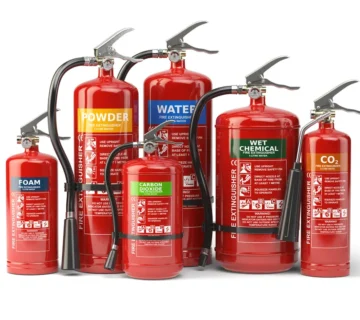

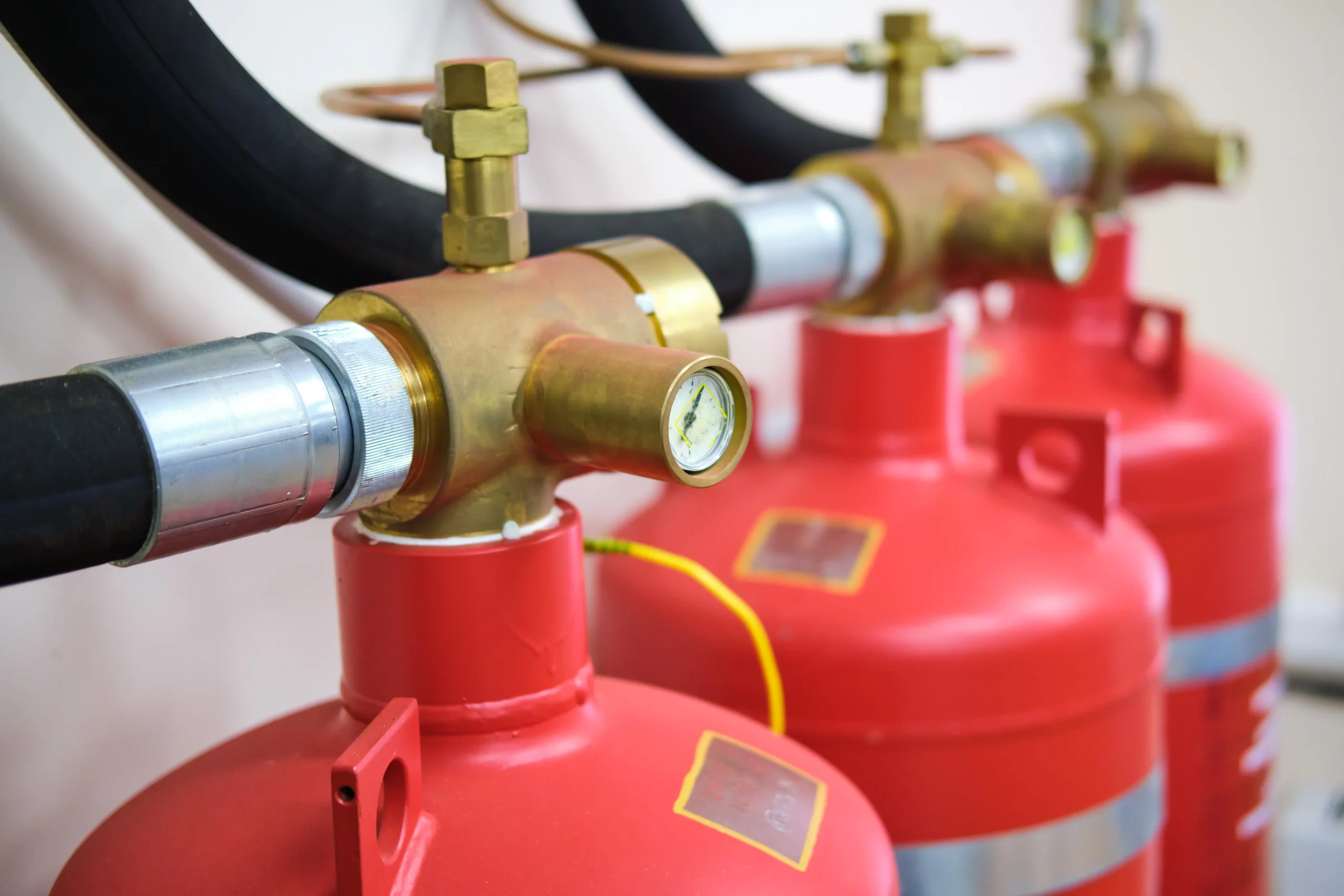
When facility owners ask what gas is used in fire suppression systems, they are rarely looking for a single name.
They are usually trying to understand which solution best protects people, assets, and operations without causing secondary damage.
From a marketing and engineering perspective at DARS, this question sits at the intersection of safety, compliance, and business continuity.
The answer depends on how fire behaves, how spaces are occupied, and which standards govern the project.
Across Saudi Arabia, gaseous fire suppression is widely specified for hospitals, data halls, control rooms, and industrial facilities.
Water-based systems are not always suitable where electronics or high‑value assets are present.
This is where gas-based systems provide a clean, fast, and predictable response.
Understanding the fundamentals helps decision‑makers avoid costly mistakes later in the project lifecycle.
Why This Question Matters for Saudi Facilities
In Saudi projects, fire suppression choices are influenced by more than performance alone.
Approvals from Civil Defense, alignment with the Saudi Building Code, and system registration through official portals all shape the final design.
DARS frequently supports clients through these processes, especially for mission‑critical facilities.
Selecting the right suppression gas early reduces redesigns and approval delays.
The Kingdom’s rapid growth in digital infrastructure has also changed expectations.
Data center fire protection systems demand agents that extinguish fire without harming servers or interrupting uptime.
As a result, gaseous systems have become a strategic choice rather than a niche solution.
This naturally leads back to the core question of what gas is used in fire suppression systems and why.
How Gaseous Fire Suppression Works
At a basic level, gaseous systems extinguish fire by interfering with the fire triangle.
They either absorb heat, reduce oxygen concentration, or interrupt the chemical reaction of combustion.
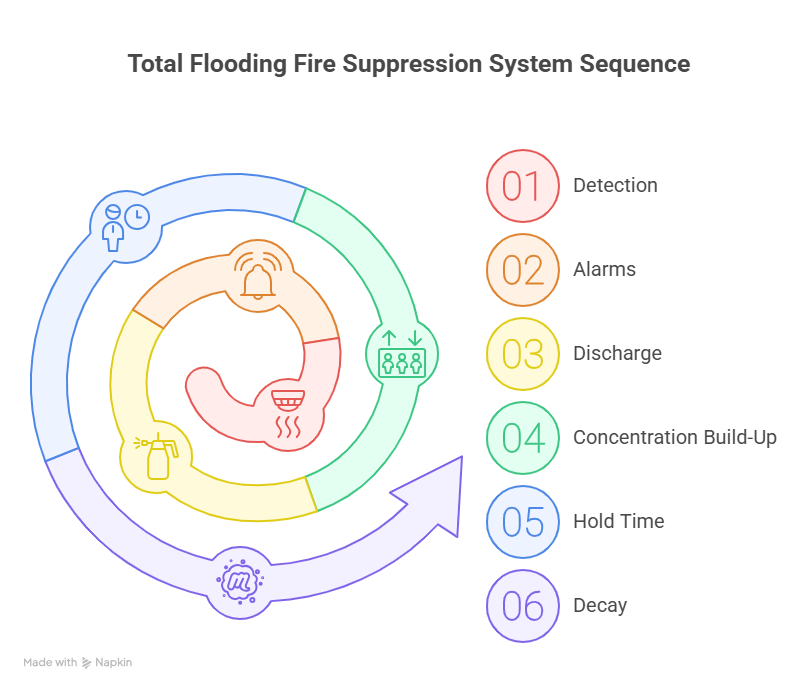
Most modern designs operate as a total flooding fire suppression system, meaning the agent fills the protected enclosure to a precise concentration.
This approach allows fires to be controlled in seconds rather than minutes.
Total Flooding vs. Local Application
Total flooding systems assume the room is enclosed and can hold the agent long enough to be effective.
This requirement links directly to enclosure sealing and post‑discharge hold time.
Standards such as NFPA 2001 define minimum hold periods to prevent re‑ignition.
These requirements explain why room integrity testing is a recurring topic during commissioning.
The Main Categories of Fire Suppression Gases
When discussing what gas is used in fire suppression systems, professionals typically group agents into three categories.
Each category behaves differently and suits different risk profiles.
DARS frames this choice around safety, equipment sensitivity, and regulatory acceptance.
Understanding these categories simplifies early decision‑making.
Clean Agent Fire Suppression Systems
Clean agents are chemically engineered gases that extinguish fire without leaving residue.
They are widely accepted in occupied spaces and sensitive environments.
For this reason, clean agent fire suppression dominates specifications for commercial and institutional buildings.
Their performance is governed by well‑established international standards.
FM‑200 (HFC‑227ea) Systems
The FM‑200 (HFC‑227ea) system remains one of the most recognized clean agents globally.
It suppresses fire by absorbing heat and interrupting the combustion process.
Its design and application are clearly defined under the NFPA 2001 standard, making it familiar to authorities and consultants.
This familiarity often simplifies approvals in large Saudi projects.
However, environmental considerations are now part of long‑term planning.
HFC‑based agents are being reviewed globally due to climate commitments.
Saudi Arabia’s participation in international environmental agreements has made this topic more relevant for asset owners.
This trend has opened the door to alternative clean agents.
Novec 1230 Clean Agent
The Novec 1230 clean agent, also known as FK‑5‑1‑12, has gained strong traction in recent years.
It extinguishes fire through heat absorption while offering a lower atmospheric lifetime.
Its profile aligns well with environmentally friendly fire suppression strategies.
Designers often reference both NFPA 2001 and ISO 14520 when specifying this agent.
In Saudi facilities where sustainability targets are increasingly visible, Novec 1230 is often positioned as a future‑focused option.
DARS commonly evaluates its suitability during early design workshops.
This ensures that environmental goals do not compromise system effectiveness or compliance.
The discussion naturally extends to non‑chemical alternatives.
Inert Gas Fire Suppression Systems
Inert gas fire suppression relies on naturally occurring gases rather than chemical compounds.
These systems reduce oxygen concentration to a level where combustion cannot continue.
They do not chemically interact with the fire, which makes their behavior highly predictable.
This predictability appeals to operators managing long‑term risks.
IG‑541 Inert Gas Blend
The IG‑541 inert gas blend, often referred to as Inergen®, combines nitrogen, argon, and carbon dioxide.
It is designed to lower oxygen while stimulating human breathing through a small CO₂ component.
This balance supports occupant safety when systems are properly designed and signaled.
Such systems are commonly used in control rooms and archival spaces.
Because inert gases are naturally present in the atmosphere, they avoid many environmental concerns.
They are recognized under ISO 14520 and accepted by major authorities.
In Saudi Arabia, these systems are often specified for high‑value assets with long service life expectations.
This makes them a strategic choice rather than a short‑term fix.
Carbon Dioxide (CO₂) Suppression Systems
Carbon dioxide (CO₂) suppression represents one of the oldest forms of gaseous fire protection.
CO₂ extinguishes fire by rapidly reducing oxygen concentration.
While highly effective, it introduces significant life‑safety considerations.
For this reason, its use is restricted to normally unoccupied spaces.
International guidance, including occupational safety limits outlined by organizations such as OSHA, reinforces the need for strict controls.
Pre‑discharge alarms and evacuation protocols are mandatory.
DARS typically limits CO₂ recommendations to industrial risks where alternatives are impractical.
This reinforces the importance of context when asking what gas is used in fire suppression systems.
Standards and Approvals Shaping Gas Selection
No discussion of gaseous suppression is complete without addressing standards.
In Saudi Arabia, the Saudi Building Code references international benchmarks such as NFPA and ISO.
Designers must also consider Civil Defense requirements and digital approvals through platforms like the Salama portal.
These frameworks ensure consistency and life safety across projects.
From a strategic standpoint, choosing an NFPA 2001 compliant system reduces uncertainty.
It aligns design intent with authority expectations and simplifies inspections.
DARS often integrates these considerations alongside broader risk assessments available through its risk management services.
This approach links technical decisions with operational resilience.
Environmental Direction and Long‑Term Planning
Environmental responsibility now influences fire protection planning worldwide.
Saudi Arabia’s alignment with global climate agreements, including those overseen by the UN Ozone Secretariat, has practical implications for system selection.
Agents with lower global warming impact are increasingly favored for new facilities.
This trend reshapes conversations around legacy systems and future upgrades.
For asset owners, this means the question is no longer just what gas is used in fire suppression systems today.
It also becomes about which agent will remain acceptable and serviceable over the system’s lifespan.
DARS’s advisory approach helps clients balance compliance, sustainability, and performance.
These considerations set the stage for a deeper comparison of system choices.
Clean Agents vs Inert Gases: How DARS Helps Clients Choose the Right Gas
After understanding the main categories, the question what gas is used in fire suppression systems becomes more practical: which option fits a specific room, risk, and approval path.
DARS typically frames this choice as a balance between life safety, equipment protection, and long‑term feasibility.
In many Saudi projects, the “best” agent is the one that performs reliably and remains straightforward to maintain, certify, and refill over time.
That decision starts with how the space is used, not with which agent is trending.
Occupied Spaces and Life Safety Expectations
Where people may be present, clean agents and inert gases can both be viable, but the reasoning differs.
A Novec 1230 clean agent or an FM-200 (HFC-227ea) system is often selected because it can suppress fires rapidly in compact designs, especially in commercial and healthcare environments.
Inert systems, such as the IG-541 inert gas blend, can also protect occupied spaces when designed to safe exposure limits and supported by proper alarms and delays.
DARS aligns these decisions with internationally recognized guidance like NFPA 2001 to reduce ambiguity during approvals.
A key practical point is that “safe” is not a marketing claim; it is an engineered outcome.
Exposure limits, time delays, and signage are part of the design, not add‑ons.
This is why DARS often discusses human factors early, long before cylinders are ordered.
That early clarity directly lowers change requests later in the project.
Electronics, Assets, and Downtime Risk
In environments built around uptime, clean agent fire suppression is often the default because it leaves no residue and avoids water damage.
This matters most in data center fire protection systems, where even a small incident can trigger cascading operational costs.
DARS will often align protection strategies with broader IT fire protection expectations outlined in standards like NFPA 75 for information technology equipment rooms.
The goal is simple: extinguish quickly, protect assets, and support fast recovery.
That said, inert gas fire suppression can be a strong fit for sensitive rooms as well, particularly where environmental priorities are high.
Because inert agents are naturally occurring, they support environmentally friendly fire suppression positioning for organizations with public sustainability commitments.
The trade‑off is usually physical: inert systems often need more cylinder storage volume and may require stronger infrastructure planning.
This is where DARS’s role becomes consultative, translating technical trade‑offs into business decisions.
Space, Infrastructure, and the “Cylinder Reality”
In Saudi Arabia, many projects face a common constraint: space is valuable, and plant rooms are rarely oversized.
Clean agents are frequently chosen because the storage footprint can be smaller, especially when the protected volume is moderate and enclosure integrity is strong.
Inert gas systems, while excellent for many risks, can require more cylinders due to the larger volume of gas needed to achieve the design concentration.
DARS uses this reality to guide early architectural coordination, because “where do the cylinders go?” is not a small question on a live site.
This also connects to pipework, discharge pressure, and pressure relief planning.
Some systems discharge at higher pressures, which affects nozzle selection and sometimes acoustic considerations.
A well‑designed solution anticipates these engineering needs rather than reacting to them at commissioning.
That’s why DARS often reviews system layouts alongside MEP coordination, not in isolation.
Safety and Human Health: What Stakeholders Need to Know
When people search what gas is used in fire suppression systems, they are often quietly asking, “Is it safe if someone is inside?”
DARS treats that question with the seriousness it deserves, because gaseous suppression is not only about extinguishing fire.
It is also about controlling exposure, ensuring evacuation time, and preventing panic during discharge events.
The system’s safety features should be as well‑planned as the agent itself.
Safe Exposure Limits and Design Intent
Clean agents such as FM‑200 and Novec 1230 are commonly specified for occupied spaces when designed within allowable exposure limits.
These limits are not arbitrary; they are defined through standardized testing and referenced in design documentation and codes.
Using an NFPA 2001 compliant approach makes it easier to document why a chosen design concentration is acceptable and how it will be achieved.
This matters in formal submittals and during authority review.
Inert gases operate differently, and that changes the conversation.
They reduce oxygen to a level that stops combustion, but the design must keep oxygen within ranges considered acceptable for short exposure periods in occupied spaces.
This is where system signaling and discharge controls become essential, not optional.
DARS typically positions training and signage as part of operational readiness, not a final checklist item.
Pre‑Discharge Alarms, Time Delays, and Evacuation Behavior
A gaseous system should never “surprise” the people in a room.
Best practice is to provide clear audible and visual warning, time delays, and manual abort features where appropriate.
These measures give occupants time to exit calmly and reduce the risk of unsafe exposure.
Occupational guidance and hazard communication principles from bodies like OSHA reinforce why clear procedures matter around suppression agents.
In Saudi facilities with mixed-use occupancy—think hospitals, offices, and operational control rooms—this human element becomes even more important.
DARS often supports clients by aligning system behavior with building operations, including security protocols and emergency response procedures.
It is also why many clients request walkthroughs and drills after commissioning, especially in critical facilities.
Confidence during an alarm is built long before an incident.
CO₂: Effective, but Not for Casual Use
Carbon dioxide (CO₂) suppression remains a powerful solution for certain industrial risks, but it requires strict safeguards.
Because it can reduce oxygen to dangerous levels, it is generally reserved for normally unoccupied spaces and special hazards.
This is not a technical footnote; it is a defining limitation.
DARS’s guidance is typically conservative here: CO₂ is recommended only when the risk profile and operations can support the required controls.
System Design Considerations That Decide Whether the Gas Works
Even the best agent choice can fail if the room cannot hold the concentration.
This is why DARS connects the question what gas is used in fire suppression systems to a second, equally important question: “Can the enclosure support the design?”
Design is not only about cylinders and pipe sizes; it is about airflow, leakage, and coordination with the building’s mechanical systems.
A suppression system is only as strong as the environment it is installed into.
Calculating Agent Quantity: More Than Just Room Volume
Agent quantity is based on protected volume and required design concentration, but real projects add complexity.
Temperature impacts gas density, and local environmental conditions can influence how the agent behaves after discharge.
Saudi sites often face high ambient temperatures, which makes correct engineering even more important for predictable performance.
DARS’s approach typically includes disciplined data collection—room dimensions, obstructions, and HVAC behavior—before final sizing is confirmed.
For stakeholders, the practical takeaway is that “rule of thumb” sizing is risky.
Accurate calculations protect budgets because they reduce the chances of under‑design, rework, or surprise cylinder additions.
They also protect safety, because the required concentration must be achieved without guesswork.
This is where standards like ISO 14520 are often referenced alongside NFPA guidance.
Room Integrity and Hold Time: The Hidden Make‑or‑Break Factor
Most gaseous systems are designed as a total flooding fire suppression system, which assumes the agent stays in the room long enough to prevent re‑ignition.
Hold time is not a “nice to have”; it is fundamental to system effectiveness.
If air leakage is high, the concentration decays too quickly and the fire can return even after initial knockdown.
That is why room integrity testing is a frequent topic in serious project discussions.
In practice, the integrity conversation usually leads to doors, cable penetrations, ceiling voids, and unsealed service risers.
DARS often coordinates these details with fit‑out teams because sealing is rarely owned by a single contractor.
This coordination is also why many clients prefer one accountable partner for design, installation, and testing.
It reduces the “not my scope” gaps that cause commissioning delays.
Pressure Relief, HVAC Shutdown, and Real‑World Air Movement
Discharging gas changes room pressure, and that pressure must be managed safely.
Pressure relief venting is often required to protect doors, walls, and ceiling systems from damage.
HVAC shutdown logic is also critical, because active ventilation can pull agent out of the room immediately after discharge.
DARS typically treats HVAC integration as a core design task, not a late-stage control-wiring detail.
This is especially relevant in server rooms and electrical spaces where cooling systems are powerful and continuous.
If airflow is not controlled, even an excellent clean agent selection can underperform in practice.
That is why DARS often reviews suppression strategies alongside mechanical design priorities.
It keeps the protection plan aligned with how the facility actually runs.
Installation, Commissioning, and Real‑World Readiness in Saudi Arabia
By the time a client feels confident answering what gas is used in fire suppression systems for their facility, attention naturally shifts to execution.
Even the best agent choice can fall short if installation and commissioning are rushed or fragmented.
DARS approaches this phase as a continuation of risk management, not a handover point.
The objective is simple: ensure the system performs exactly as designed when it is needed most.
In Saudi Arabia, gaseous fire suppression projects are closely reviewed by authorities.
Cylinder placement, pipe routing, detection logic, and release controls must all match approved drawings.
Any deviation discovered late can trigger rework or delays in occupancy.
This is why DARS emphasizes disciplined installation management from day one.
Commissioning: Proving the System Works
Commissioning is where theory meets reality.
It verifies that detection activates correctly, alarms function as intended, and the agent discharges according to design logic.
For clean agent and inert gas systems alike, commissioning confirms that all safety interlocks are operational.
This process builds trust with both authorities and facility operators.
Room integrity testing is a particularly critical milestone.
A system designed as a total flooding fire suppression system relies on the enclosure holding the agent concentration long enough to prevent re‑ignition.
Door fan testing demonstrates whether leakage paths compromise this hold time.
DARS often treats this test as a design validation step, not merely a compliance checkbox.
Training and Handover: The Human Side of Fire Protection
A suppression system does not operate in isolation; people interact with it long after commissioning.
Operators must understand alarms, delays, and emergency procedures to respond confidently during an event.
DARS integrates training into the handover phase so that the system’s behavior is familiar, not alarming.
This is especially important in occupied facilities such as hospitals and operational control centers.
Clear documentation also supports long‑term reliability.
As‑built drawings, calculation reports, and maintenance schedules form the backbone of future inspections.
When these records are incomplete, even a compliant system can become difficult to manage.
This attention to detail reflects DARS’s broader commitment to operational continuity, not just installation.
Maintenance, Refilling, and Lifecycle Planning
Fire suppression systems are long‑term assets, not one‑time installations.
Maintenance requirements should influence agent selection just as much as performance characteristics.
Clients asking what gas is used in fire suppression systems are increasingly thinking ahead to serviceability.
In Saudi Arabia, this practical mindset is essential for uninterrupted operations.
Routine Inspection and Testing
Clean agent and inert gas systems require regular inspection to remain compliant and reliable.
Cylinder pressure checks, valve inspections, and detection testing are part of standard maintenance regimes.
Authorities often require documented evidence that these activities are performed on schedule.
DARS aligns maintenance planning with local expectations and international guidance.
Hydrostatic testing intervals for cylinders are another practical consideration.
Planning these tests in advance helps avoid unplanned downtime or compliance gaps.
For mission‑critical sites, DARS often advises redundancy strategies to maintain protection during servicing.
This proactive approach supports uninterrupted business operations.
Refilling and Local Availability
After a discharge event, refilling speed becomes a critical factor.
Clients want reassurance that the selected agent can be sourced and replenished locally.
This is particularly relevant for agents like FM‑200 and Novec 1230, which require certified handling.
DARS’s familiarity with local supply chains reduces uncertainty during recovery planning.
Inert gases offer a different advantage here.
Because they are naturally occurring, refilling logistics can be simpler in certain contexts.
This can support long‑term resilience planning, especially for industrial facilities.
Such practical insights often shape final recommendations during design reviews.
Regulatory Compliance and Approvals in the Saudi Context
In Saudi Arabia, fire suppression systems are reviewed through a structured approval framework.
Civil Defense expectations, digital registration, and alignment with the Saudi Building Code all influence acceptance.
DARS routinely guides clients through these pathways to avoid last‑minute surprises.
Compliance is treated as an integrated design objective, not an external hurdle.
Civil Defense and Digital Approval Pathways
Fire suppression systems must be approved and registered through official channels before occupancy.
Platforms such as the Salama portal have formalized this process.
Accurate documentation, compliant design, and tested systems all contribute to smoother approvals.
DARS’s experience with these workflows helps clients anticipate authority requirements early.
For industrial and high‑risk projects, additional oversight may apply.
Coordination with industrial security authorities ensures that suppression strategies align with operational risk profiles.
This layered review reinforces why early clarity on agent choice and system behavior is so valuable.
It reduces the risk of redesign under regulatory pressure.
International Standards as the Common Language
International standards provide a shared reference point between designers, contractors, and authorities.
Specifications that are NFPA 2001 compliant or aligned with ISO 14520 are easier to justify and review.
These standards also support consistent interpretation across projects.
DARS leverages this consistency to streamline discussions with stakeholders.
For specialized environments, additional standards may apply.
For example, IT‑heavy facilities often reference NFPA 75 to align fire protection with technology risks.
This layered standards approach ensures that suppression systems are not designed in isolation.
Instead, they become part of a broader safety ecosystem.
Environmental Direction and Future‑Proofing Decisions
Environmental considerations are reshaping how organizations think about fire suppression.
Saudi Arabia’s alignment with global environmental initiatives, including commitments tracked by the UN Ozone Secretariat, has long‑term implications.
Agents with lower global warming impact are gaining attention in new developments.
This trend directly influences conversations around system upgrades and replacements.
For some facilities, this means transitioning away from legacy HFC‑based systems over time.
For others, it means specifying alternatives like inert gases or newer clean agents from the outset.
DARS helps clients frame these decisions in terms of lifecycle value, not short‑term cost alone.
This perspective supports sustainable planning without compromising safety.
Bringing It All Together: Making the Right Choice
By now, the question what gas is used in fire suppression systems has evolved into a strategic discussion.
It is no longer just about naming an agent, but about understanding how that agent fits the facility’s people, assets, and regulatory environment.
Clean agents, inert gases, and CO₂ each serve a purpose when applied thoughtfully.
The key is matching the solution to the real‑world context.
DARS’s role is to connect technical detail with operational clarity.
From early risk assessment to commissioning and long‑term maintenance, each phase builds on the last.
This integrated approach reduces uncertainty and supports reliable protection over the system’s lifespan.
It is also why many clients view fire suppression as an investment rather than a compliance cost.
For organizations planning new projects or upgrades, the most effective starting point is informed guidance.
Resources such as DARS’s services overview, frequently asked questions, and practical insights in its articles section provide useful context.
Combined with professional consultation, they help decision‑makers move forward with confidence.
In the end, choosing the right gas is about protecting what matters most—safely, compliantly, and sustainably.