
Introduction: Why Centralized Fire Monitoring Is No Longer Optional
In today’s rapidly evolving urban landscape, safety is no longer a passive requirement. It has become a strategic priority, especially in regions like Saudi Arabia where large-scale developments, industrial zones, and high-rise buildings are expanding under Vision 2030. At the heart of this transformation lies the central fire alarm monitoring system, a critical component of modern building safety infrastructure.
A central fire alarm monitoring system is not just another layer of protection. It represents a shift from reactive safety measures to proactive risk management. By enabling real-time fire detection and 24/7 alarm monitoring, these systems ensure that potential threats are identified, verified, and acted upon without delay.
According to global safety standards such as NFPA 72 National Fire Alarm Code, centralized monitoring plays a vital role in reducing response time and improving emergency outcomes. This is particularly relevant in Saudi Arabia, where compliance with Civil Defense regulations is mandatory for many types of facilities.
As organizations continue to prioritize safety, understanding how these systems work and why they matter becomes essential. This article explores the concept, components, and operational logic behind central fire alarm monitoring systems, starting with the fundamentals.
What Is a Central Fire Alarm Monitoring System?
Defining the Core Concept
A central fire alarm monitoring system is a centralized platform that collects, processes, and displays signals from multiple fire alarm control panels (FACPs) across one or more buildings. Instead of relying on isolated systems, it creates a unified environment where operators can monitor all fire-related events in real time.
This centralization allows for centralized alarm control, ensuring that alerts are not only detected but also managed efficiently. Operators can quickly assess the situation, verify alarms, and initiate appropriate responses, whether manual or automated.
Why Centralization Matters
Traditional fire alarm systems operate independently within each building. While effective to a degree, they lack coordination. A central monitoring system bridges this gap by connecting all detection points into a single control interface.
This is particularly important in large-scale environments such as:
- Industrial complexes
- Commercial towers
- Residential compounds
In these settings, a centralized approach significantly improves response times and ensures consistency in emergency handling.
The Role of Central Monitoring in Saudi Arabia
Regulatory Importance and Compliance
In Saudi Arabia, the implementation of a central fire alarm monitoring system is not just recommended, it is often required. Regulatory frameworks such as the Saudi Building Code (SBC 801) and Civil Defense guidelines mandate the use of fire safety compliance systems in high-risk and high-occupancy buildings.
Organizations must meet strict requirements to obtain occupancy permits and maintain operational licenses. These include system integration, regular inspections, and documented testing protocols. Resources like the Saudi Building Code official platform provide detailed guidelines on compliance requirements.
Failing to comply can lead to operational shutdowns, penalties, or even legal consequences. This makes central monitoring systems a necessity rather than a luxury.
Alignment with Vision 2030
Saudi Arabia’s Vision 2030 initiative emphasizes smart cities, digital transformation, and infrastructure modernization. Central fire alarm monitoring systems align perfectly with this vision by enabling intelligent fire alarm systems that integrate with broader smart building technologies.
From Riyadh’s financial districts to industrial hubs in Jubail and Dammam, centralized monitoring is becoming a standard feature in modern developments. It supports not only safety but also operational efficiency and data-driven decision-making.
Key Components of a Central Fire Alarm Monitoring System
Understanding the System Architecture
A central fire alarm monitoring system is built on a combination of hardware and software components that work together seamlessly. Each element plays a specific role in ensuring accurate detection, communication, and response.
At its core, the system includes:
- Fire Alarm Control Panels (FACPs)
- Central monitoring server or workstation
- Network communication modules
- Data logging and reporting tools
These components are interconnected through wired or hybrid networks to ensure reliability and minimal downtime.
How Components Work Together
When a detector senses smoke, heat, or flame, it sends a signal to the local FACP. This signal is then transmitted to the central monitoring system, where it is displayed and categorized based on priority.
The system’s software interface allows operators to:
- View real-time alerts
- Access historical data logs
- Identify the exact location of the incident
This level of visibility is essential for effective fire alarm monitoring services, especially in large or multi-site environments.
How a Central Fire Alarm Monitoring System Works
The End-to-End Process
The functionality of a central fire alarm monitoring system can be broken down into a sequence of events that ensure rapid detection and response.
The process begins with detection and ends with action:
- Detection: Sensors identify abnormal conditions such as smoke or heat
- Transmission: Signals are sent to the FACP and then to the central system
- Processing: The system prioritizes and logs the event
- Response: Operators verify and initiate emergency protocols
Each step is designed to minimize delay and maximize accuracy.
Real-Time Monitoring and Decision-Making
One of the key advantages of central systems is their ability to provide remote alarm monitoring capabilities. Operators can oversee multiple locations from a single control room, ensuring consistent oversight across all sites.
This is particularly valuable in industries where downtime or delayed response can have significant consequences. By combining real-time fire detection with centralized control, organizations can maintain a high level of preparedness at all times.
Alert Workflow and Emergency Response Integration
From Detection to Action
Once an alarm is triggered, the system follows a structured workflow to ensure that the situation is handled efficiently. This workflow is designed to eliminate confusion and ensure that every step is documented and executed correctly.
The typical workflow includes:
- Instant alert generation and system notification
- Operator verification through system interface or CCTV integration
- Automatic or manual escalation to emergency services
In Saudi Arabia, this often includes direct communication with Civil Defense through emergency numbers such as 998.
Integration with Emergency Systems
Modern systems go beyond simple alerting. They are designed for full emergency response integration, connecting with other building systems such as:
- Sprinkler and suppression systems
- HVAC shutdown controls
- Elevator recall mechanisms
This integration ensures that once a fire is detected, the building responds as a unified system rather than a collection of isolated components.
The Advantage of Centralized Alarm Control
Improving Response Time and Accuracy
One of the most significant benefits of centralized monitoring is the reduction in response time. Studies and industry benchmarks indicate that centralized systems can reduce response times by up to 50 percent compared to standalone systems.
This improvement is not just about speed. It also enhances accuracy by providing operators with complete visibility and contextual information. This allows for better decision-making and reduces the risk of false alarms or delayed responses.
Enabling Multi-Site Monitoring
For organizations managing multiple facilities, a central fire alarm monitoring system offers unmatched scalability. It allows a single team to monitor multiple buildings, ensuring consistency and efficiency across all locations.
This is particularly relevant for large enterprises and government entities that require standardized safety protocols across their operations.
Connecting Safety with Business Continuity
Why Fire Monitoring Is a Strategic Investment
Beyond compliance and safety, central fire alarm monitoring systems play a crucial role in business continuity. A fire incident can lead to operational disruptions, financial losses, and reputational damage.
By investing in advanced fire protection systems, organizations can mitigate these risks and ensure uninterrupted operations. This aligns with broader risk management strategies and supports long-term sustainability.
The Role of DARS in Fire Safety Solutions
As a trusted provider of safety solutions, DARS focuses on delivering systems that meet both regulatory requirements and operational needs. Through its range of services, the company supports organizations in implementing reliable and scalable fire monitoring systems.
Their approach emphasizes precision, compliance, and long-term performance, ensuring that clients are not only protected but also fully aligned with industry standards.
Installation Requirements for Central Fire Alarm Monitoring Systems
Planning the System for Real-World Conditions
Implementing a central fire alarm monitoring system begins long before installation. It starts with a detailed site assessment that evaluates the building’s structure, risk level, occupancy type, and operational requirements. This initial phase is critical because it determines how effectively the system will perform under real emergency conditions.
A properly designed system ensures seamless communication between all components, from detectors to the central control room. It also considers future scalability, especially in environments expected to expand. This forward-thinking approach aligns with modern fire protection systems, where adaptability is just as important as reliability.
Wiring, Networking, and System Integration
Once the planning phase is complete, the installation process focuses on connecting all fire alarm control panels to the central monitoring unit. In Saudi Arabia, wired networks are often preferred due to their stability and resistance to interference. These connections ensure uninterrupted 24/7 alarm monitoring, which is essential for high-risk environments.
The system is then integrated with other building technologies such as Building Management Systems (BMS) or SCADA platforms. This integration enhances centralized alarm control by allowing operators to monitor not just fire events but also related systems like ventilation and power.
Commissioning and System Testing
After installation, the system undergoes a commissioning phase where every component is tested under simulated conditions. This includes triggering alarms, verifying communication pathways, and ensuring that alerts are displayed accurately on the central interface.
Authorities such as the Saudi Civil Defense require thorough testing before granting approval. Without proper commissioning, even the most advanced systems cannot guarantee safety or compliance.
Compliance Standards and Regulatory Framework
Understanding Saudi Safety Regulations
In Saudi Arabia, compliance is a foundational requirement for any fire safety system. A central fire alarm monitoring system must adhere to multiple standards, including SBC 801, NFPA 72, and SASO guidelines. These frameworks define how systems should be designed, installed, and maintained.
The International Code Council provides global insights into building safety codes, many of which influence local regulations. These standards ensure that systems are not only functional but also consistent across different types of facilities.
Why Compliance Is Non-Negotiable
Compliance is not simply about meeting legal requirements. It directly impacts the safety of occupants and the operational continuity of businesses. Non-compliance can lead to severe consequences, including fines, shutdowns, and loss of insurance coverage.
Organizations that invest in robust fire safety compliance systems position themselves as responsible and forward-thinking. They reduce risk exposure while also enhancing their reputation in the market.
Maintenance and Testing Protocols
Ensuring Long-Term System Reliability
A central fire alarm monitoring system is only as effective as its maintenance routine. Over time, components can degrade, connections can weaken, and software can become outdated. Regular maintenance ensures that the system remains fully operational at all times.
Maintenance protocols typically include visual inspections, functional testing, and system diagnostics. These activities help identify potential issues before they escalate into critical failures.
Scheduled Testing and Performance Checks
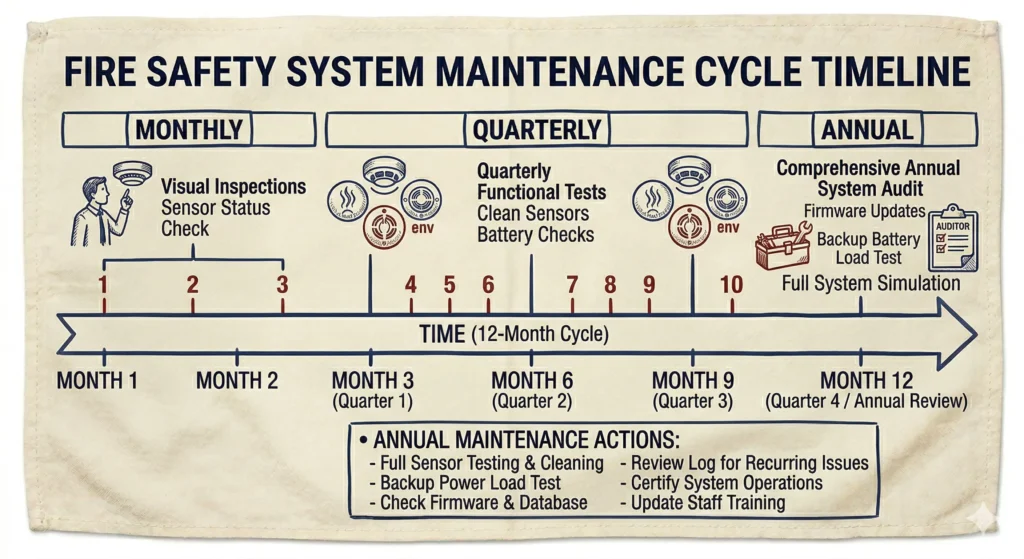
Testing is conducted at different intervals to ensure comprehensive coverage. Monthly checks focus on basic functionality, while quarterly tests simulate real fire scenarios. Annual audits involve a complete system review, including documentation and compliance verification.
According to UL Solutions, regular testing significantly reduces system failure rates and improves overall safety performance. This highlights the importance of consistent monitoring and evaluation.
The Cost of Neglect
Neglecting maintenance can have serious consequences. Even minor faults can compromise the entire system, leading to delayed responses or false alarms. In regulated environments, this can result in penalties or operational restrictions.
By prioritizing maintenance, organizations ensure that their remote alarm monitoring capabilities remain reliable and effective, even under challenging conditions.
Common Faults and Operational Challenges
Identifying System Vulnerabilities
Despite their advanced design, central fire alarm monitoring systems are not immune to faults. Common issues include wiring failures, sensor malfunctions, and panel overloads. These problems can disrupt communication and reduce system efficiency.
Understanding these vulnerabilities is essential for proactive management. It allows organizations to address issues before they impact safety or compliance.
The Role of Diagnostics and Smart Monitoring
Modern systems are increasingly incorporating IoT-based diagnostics, enabling predictive maintenance and real-time fault detection. These technologies enhance intelligent fire alarm systems by providing deeper insights into system performance.
With advanced diagnostics, operators can identify the root cause of issues quickly and implement corrective actions without delay. This reduces downtime and ensures continuous protection.
Cost Considerations and Investment Factors
Understanding the Cost Structure
The cost of implementing a central fire alarm monitoring system varies depending on several factors, including the size of the facility, the number of zones, and the level of system integration. In Saudi Arabia, installation costs can range from moderate to high, depending on complexity.
Operational costs also include annual maintenance contracts and system upgrades. These ongoing expenses are essential for maintaining performance and compliance.
Factors That Influence Pricing
Several key factors determine the overall investment required for a system:
- Scale and complexity of the building or facility
- Level of integration with other systems
- Service agreements for monitoring and maintenance
Organizations must evaluate these factors carefully to ensure that their investment delivers maximum value.
Viewing Safety as a Long-Term Asset
While the initial cost may seem significant, a central fire alarm monitoring system should be viewed as a long-term asset. It protects lives, safeguards property, and ensures business continuity.
By investing in advanced fire alarm monitoring services, organizations not only meet regulatory requirements but also create a safer and more resilient operational environment.
Integration with Smart Building Systems
Connecting Fire Safety with Modern Infrastructure
As buildings become smarter, the integration of fire safety systems with other technologies becomes increasingly important. A central fire alarm monitoring system can connect with BMS, SCADA, and IoT platforms to create a unified control environment.
This integration enhances emergency response integration by enabling automated actions such as shutting down ventilation systems or activating suppression mechanisms.
Supporting Data-Driven Decision Making
Integrated systems generate valuable data that can be analyzed to identify trends and improve safety strategies. This data-driven approach supports proactive risk management and aligns with the goals of Vision 2030.
Organizations that adopt integrated solutions gain a competitive advantage by combining safety with operational intelligence.
The Future of Central Fire Alarm Monitoring Systems
Moving Toward Predictive Safety
The future of fire safety lies in predictive technologies that anticipate risks before they occur. Advances in AI and IoT are transforming central monitoring systems into intelligent platforms capable of analyzing patterns and detecting anomalies.
This evolution is redefining how organizations approach safety, shifting from reactive measures to proactive strategies.
Aligning with Global Best Practices
Global standards continue to evolve, and Saudi Arabia is aligning its regulations with international best practices. Resources like the National Institute of Standards and Technology provide insights into emerging technologies and safety frameworks.
By staying ahead of these trends, organizations can ensure that their systems remain compliant and effective in the long term.
The Strategic Advantage of Central Fire Alarm Monitoring Systems
Moving Beyond Compliance to Competitive Advantage
By this stage, it becomes clear that a central fire alarm monitoring system is not just a regulatory requirement. It is a strategic investment that directly impacts operational resilience, safety culture, and long-term business performance. Organizations that treat fire safety as a core business function, rather than a checkbox exercise, position themselves for sustained growth and stability.
Centralized systems enable faster decision-making, reduce uncertainty during emergencies, and provide complete visibility across facilities. This level of control transforms safety from a reactive function into a proactive management tool. It also aligns with global expectations for modern building safety infrastructure, where integration and intelligence are key.
Enhancing Organizational Confidence and Reputation
Safety is closely tied to trust. Clients, employees, and stakeholders expect organizations to maintain environments that prioritize protection and preparedness. A well-implemented central monitoring system signals a commitment to high standards and responsible operations.
This becomes especially important in sectors such as manufacturing, real estate, and hospitality, where safety incidents can have lasting reputational consequences. By leveraging advanced fire alarm monitoring services, organizations demonstrate reliability and accountability, which strengthens their market position.
Central Monitoring vs Traditional Fire Alarm Systems
Understanding the Difference in Capability
Traditional fire alarm systems operate within isolated environments, limiting their effectiveness in large or complex facilities. In contrast, a central fire alarm monitoring system creates a unified ecosystem where all alarms are tracked, verified, and managed from a single point.
This difference is not just technical. It directly impacts response time, coordination, and overall safety outcomes. Centralized systems provide context, allowing operators to understand the situation rather than simply react to it.
Why Centralized Systems Deliver Better Outcomes
The advantage of centralized monitoring lies in its ability to combine real-time fire detection with intelligent processing. Instead of multiple disconnected alerts, operators receive structured, prioritized information that supports faster and more accurate decisions.
This capability becomes critical in multi-building environments, where managing separate systems would otherwise lead to delays and confusion. By consolidating control, organizations create a safer and more efficient operational framework.
Improving Response Time and Emergency Coordination
The Impact of Speed in Fire Emergencies
In any fire incident, time is the most critical factor. Even a delay of a few minutes can significantly increase damage and risk to human life. A central fire alarm monitoring system addresses this challenge by enabling immediate detection, verification, and response.
Through 24/7 alarm monitoring, the system ensures that no alert goes unnoticed. Operators are always available to assess situations and initiate action, regardless of time or location.
Coordinated Emergency Response Across Systems
Modern systems are designed for seamless emergency response integration, connecting fire alarms with other building systems such as suppression, evacuation, and communication platforms. This coordination ensures that all safety measures are activated simultaneously.
This unified response reduces confusion, improves evacuation efficiency, and minimizes damage. It also ensures that emergency services receive accurate and timely information, enabling them to act more effectively upon arrival.
Data, Analytics, and Predictive Fire Safety
Turning Data into Actionable Insights
One of the most overlooked benefits of central fire alarm monitoring systems is their ability to generate and analyze data. Every alarm, fault, and system activity is logged, creating a valuable dataset that can be used to improve safety strategies.
This data enables organizations to identify patterns, detect recurring issues, and optimize system performance. It also supports compliance by providing detailed records for inspections and audits.
The Rise of Intelligent Fire Alarm Systems
With advancements in technology, central monitoring systems are evolving into intelligent fire alarm systems. These systems use analytics and machine learning to predict potential risks and recommend preventive actions.
For example, frequent minor faults in a specific zone may indicate a deeper issue that requires attention. By addressing such patterns early, organizations can prevent major incidents before they occur.
Insights from organizations like the World Economic Forum highlight how smart infrastructure is reshaping safety and risk management globally. Saudi Arabia is actively adopting these innovations as part of its digital transformation journey.
Maximizing Return on Investment (ROI)
Balancing Cost with Long-Term Value
While the implementation of a central fire alarm monitoring system requires a significant investment, the long-term benefits far outweigh the initial costs. These systems reduce the likelihood of major incidents, minimize downtime, and protect valuable assets.
Organizations that invest in advanced fire protection systems often experience lower insurance premiums and fewer operational disruptions. This makes the system not just a safety measure but a financial asset.
Key Drivers of ROI
The return on investment is driven by several factors, including improved response times, reduced risk exposure, and enhanced operational efficiency. Additionally, compliance with regulatory standards prevents costly penalties and ensures uninterrupted business operations.
By integrating remote alarm monitoring capabilities, organizations can also reduce the need for on-site personnel, further optimizing costs without compromising safety.
Best Practices for Long-Term Success
Building a Sustainable Fire Safety Strategy
To maximize the effectiveness of a central fire alarm monitoring system, organizations must adopt a holistic approach that combines technology, processes, and people. This involves regular training, system upgrades, and continuous evaluation.
Safety should not be treated as a one-time project. It requires ongoing commitment and adaptation to evolving risks and technologies.
Partnering with the Right Provider
Choosing the right partner is critical to the success of any fire safety initiative. Experienced providers ensure that systems are designed, implemented, and maintained according to the highest standards.
DARS plays a key role in this process by offering tailored solutions that align with both regulatory requirements and operational needs. Through its projects and proven track record, the company supports organizations in building reliable and scalable safety systems.
Central Fire Monitoring in the Context of Vision 2030
Supporting Smart Cities and Infrastructure Growth
Saudi Arabia’s Vision 2030 is driving the development of smart cities and advanced infrastructure. Central fire alarm monitoring systems are a fundamental part of this transformation, enabling safer and more connected environments.
By integrating with smart technologies, these systems support automation, data sharing, and real-time decision-making. This aligns with national goals for innovation and sustainability.
Future-Proofing Safety Systems
As technology continues to evolve, organizations must ensure that their safety systems remain adaptable and future-ready. Central monitoring systems provide the flexibility needed to integrate new technologies and meet emerging standards.
This future-focused approach ensures that investments made today continue to deliver value in the years ahead.
Conclusion: A Smarter Approach to Fire Safety
The central fire alarm monitoring system has become an essential component of modern safety strategies, particularly in a rapidly developing market like Saudi Arabia. It brings together detection, monitoring, and response into a single, cohesive framework that enhances both safety and efficiency.
From compliance and installation to integration and predictive analytics, these systems offer a comprehensive solution that addresses the complexities of modern infrastructure. They not only protect lives and property but also support business continuity and operational excellence.
Organizations that embrace centralized monitoring are not just meeting regulatory requirements. They are setting a higher standard for safety, reliability, and performance. With the right strategy and the right partner, they can build environments that are not only compliant but also resilient and future-ready.
In this context, DARS continues to play a vital role, delivering solutions that combine expertise, precision, and a deep understanding of local regulations. As fire safety evolves, central monitoring systems will remain at the forefront, shaping the future of protection in Saudi Arabia and beyond.