
A foam water sprinkler system combines water with an approved foam concentrate before distributing the resulting solution through sprinklers or other discharge devices. Its purpose is to provide a type of fire protection suited to hazards where water alone may not deliver the required level of control, particularly certain fires involving ignitable liquids.
The system is not simply a standard sprinkler network with foam added to the tank. It depends on a carefully engineered relationship between the water supply, foam concentrate, proportioning equipment, piping, sprinklers, detection or control equipment where applicable, and the specific fuel being protected.
Current NFPA 11 requirements cover the design, installation, and maintenance of foam-water sprinkler and spray systems. This is especially important because the former NFPA 16 standard was withdrawn, with its technical material incorporated into NFPA 11, as confirmed by the official NFPA withdrawal notice.
What Is a Foam Water Sprinkler System?
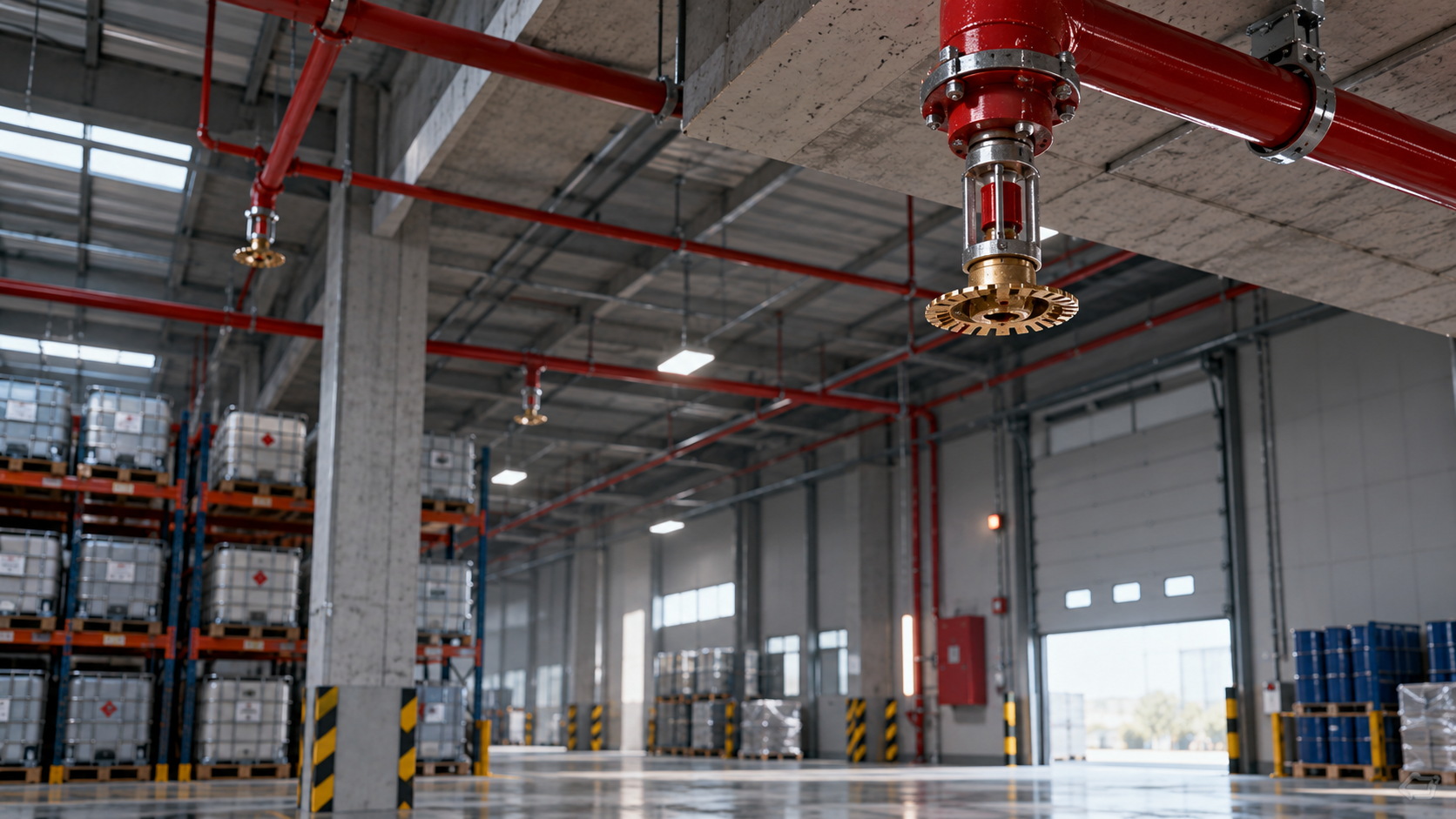
A foam water sprinkler system is a fixed piping network that uses automatic or open sprinklers to discharge foam solution over a protected hazard.
The foam solution is created by introducing a controlled amount of foam concentrate into the water supply. Once properly proportioned, that solution travels through the distribution piping and is discharged through compatible sprinklers.
The important point is that the foam concentrate, proportioning equipment, and discharge devices must work together as a tested system. UL Solutions’ guidance on firefighting foam explains that foam protection is evaluated as a complete arrangement that includes the concentrate, storage container, proportioning device, and discharge equipment.
Why Add Foam to Water?
Water is highly effective for many common combustible fires because it absorbs heat and cools burning material. Certain liquid-fuel hazards, however, can behave differently.
When an appropriate fire suppression foam is applied correctly, the resulting foam blanket can help separate the fuel surface from oxygen, suppress flammable vapours, and contribute to extinguishment or fire control while the water content provides cooling.
This makes a foam fire suppression system particularly relevant to selected Class B hazards involving flammable or combustible liquids.
Foam Does Not Make Every Sprinkler System Better
Foam should not be viewed as a universal upgrade to ordinary sprinkler protection. Different occupancies present different fire behaviours, and many buildings are effectively protected by properly designed water-based sprinkler systems.
The need for foam must come from the hazard assessment, applicable fire code, occupancy standard, insurer criteria, and system listing.
For example, NFPA 30, which addresses flammable and combustible liquids, contains protection requirements for relevant liquid-storage and processing hazards and is one of the standards that can influence when foam-water protection is appropriate.
How Does a Foam Water Sprinkler System Work?
The operating sequence begins with the water supply and the stored foam concentrate. When the system operates, a proportioning device introduces the required concentration of foam concentrate into the flowing water.
The resulting foam solution then travels through the piping network toward the sprinklers. At discharge, the system applies the solution over the hazard at the density and arrangement established by the approved design.
The exact operating sequence depends on whether the installation is wet pipe, dry pipe, preaction, deluge, or another permitted foam-water configuration.
What Does the Foam Proportioning System Do?
The proportioner is one of the most critical components in the system because foam performance depends on achieving the concentration required for the specific concentrate and application.
Too little concentrate can affect the performance of the foam solution. Incorrectly assuming that more concentrate is automatically better is also poor practice because the entire system is designed around tested concentrations and compatible components.
A properly engineered foam concentrate system therefore needs to maintain the required proportion across the expected range of system flows.
How Does the Foam Reach the Fire?
Once proportioned, the foam-water solution enters the sprinkler piping network and reaches the discharge devices.
Depending on the system arrangement, individual automatic sprinklers may operate when exposed to sufficient heat, or open discharge devices may operate together after a deluge valve is activated by the associated detection system.
This distinction directly affects how quickly the solution is delivered and how much of the protected area receives foam.
What Is the Difference Between Foam-Water and Standard Water Sprinklers?
A conventional automatic sprinkler system generally distributes water directly from the water supply through the sprinkler network. A foam sprinkler system introduces an additional suppression agent and requires equipment capable of accurately mixing and distributing that agent.
This adds design considerations that do not exist in a water-only system. Foam concentrate compatibility, storage quantity, proportioning accuracy, solution discharge density, concentrate duration, and compatibility between components all need attention.
At the same time, foam-water systems continue to rely on many familiar principles of sprinkler engineering, including hydraulic calculations, water supplies, sprinkler spacing, piping arrangements, and system supervision.
Does a Foam-Water System Still Need Water-Based Sprinkler Design?
Yes. Foam-water protection does not eliminate the underlying requirements of sprinkler engineering.
NFPA 11 specifically coordinates foam-water sprinkler design with standards including NFPA 13 for sprinkler systems, along with other fire-protection standards depending on the system configuration.
The final design must therefore satisfy both the foam application requirements and the relevant hydraulic and sprinkler requirements for the protected hazard.
What Types of Foam-Water Sprinkler Systems Are Available?
A foam fire sprinkler system can be configured in several ways depending on the hazard and operating conditions.
NFPA 11 recognises arrangements that include foam-water wet-pipe, dry-pipe, preaction, and deluge systems. The correct configuration depends on factors such as environmental conditions, required response, type of hazard, detection strategy, and acceptable foam delivery time.
This is why system type should be chosen after the fire hazard has been established, rather than treating every foam project as a standard deluge installation.
What Is an Automatic Foam Sprinkler System?
An automatic foam sprinkler system uses thermally operated sprinklers that open individually when exposed to sufficient heat.
This means the system can initially discharge through the sprinklers affected by the fire rather than operating every sprinkler simultaneously.
Depending on the system design, the network may contain water, foam solution, air, or nitrogen before operation.
What Is a Foam Water Deluge System?
A foam water deluge system uses open discharge devices connected to piping controlled by a deluge valve. When an associated detection system operates, the valve opens and foam-water solution is delivered through the open devices serving the protected zone.
Because multiple outlets can discharge together, this arrangement is often considered for hazards where rapid application across a defined area is required.
The concept differs significantly from an automatic sprinkler arrangement where individual sprinklers respond to local heat conditions.
Where Are Foam Water Sprinkler Systems Commonly Used?
A foam water sprinkler system is generally associated with occupancies where ignitable-liquid fires or spills create a hazard that may require more than conventional water-based protection.
Examples can include certain chemical processing facilities, liquid storage areas, petroleum-related operations, industrial manufacturing environments, and selected aircraft-related risks where the applicable codes and hazard analysis require foam protection.
FM Property Loss Prevention Data Sheet 4-12 provides detailed engineering guidance for foam extinguishing systems and recognises several foam-water sprinkler configurations for appropriate industrial hazards.
Why Are Ignitable Liquids a Special Concern?
A burning liquid can form a pool fire that behaves differently from a fire involving ordinary solid combustible materials.
Applying water without understanding the fuel properties can sometimes fail to provide the desired control strategy, particularly when the burning fuel remains on the surface or when spreading liquid creates a larger exposure.
An appropriately selected foam can form a protective layer over the liquid surface, helping suppress vapour release while reducing contact between the fuel and the surrounding air.
Fuel Compatibility Matters
Not every foam concentrate performs the same way on every liquid.
Hydrocarbon fuels and water-miscible or polar-solvent liquids can require different foam characteristics. Alcohols and certain other polar solvents can attack ordinary foam blankets, which is why specialised alcohol-resistant formulations may be required.
FM guidance specifically stresses that the selected foam concentrate must be compatible with the ignitable liquid being protected, making fuel identification one of the first technical steps in any industrial fire protection system using foam.
What Components Make Up a Foam Water Sprinkler System?
A complete system normally begins with a dependable water supply and a specified quantity of approved foam concentrate. A storage arrangement holds that concentrate until system operation.
Proportioning equipment then mixes concentrate with flowing water at the required ratio. The foam solution moves through control valves, distribution piping, and compatible discharge devices toward the protected hazard.
Depending on the configuration, the installation may also include detection systems, releasing controls, alarm equipment, test connections, flushing arrangements, and monitoring devices.
Why Must the Components Be Compatible?
A foam concentrate cannot be selected independently from the rest of the system.
UL emphasises that foam protection involves evaluation of the concentrate together with the proportioning and discharge equipment. NFPA 11 likewise requires components to be listed or approved for their intended application and requires foam concentrate to be suitable for the proportioning equipment and discharge devices used.
This compatibility requirement helps ensure the actual discharge performance reflects what was demonstrated during fire testing and product evaluation.
The System Starts With the Hazard, Not the Foam Tank
The most important principle behind water foam fire protection is that the hazard determines the system.
Designers first need to understand what material can burn, how it is stored or processed, how a spill could develop, what area could become involved, and what fire-protection objective is required. Only then can they establish the foam type, application density, discharge duration, system configuration, and equipment capacity.
That approach prevents a common mistake: selecting a foam fire suppression system as a collection of products before establishing the engineering basis for using them.
For Saudi industrial and commercial facilities, this planning also needs to align with the applicable Saudi fire-safety requirements and approved project design. Dar Al Hmaya’s fire protection system services cover the supply, installation, operation, inspection, and maintenance of fire and safety systems across different facility types.
The next question is therefore more detailed: how are the correct foam concentrate, proportioning method, sprinkler arrangement, application density, water supply, and discharge duration selected for a foam water sprinkler system?
How Is the Right Foam Concentrate Selected?
Once the hazard has been identified, the next design decision is choosing a foam concentrate that has been tested for the fuel and discharge arrangement being protected. A foam water sprinkler system cannot be designed around a generic assumption that all firefighting foams perform in the same way.
Foam concentrates differ in chemistry, viscosity, expansion characteristics, environmental profile, and compatibility with different fuels. UL notes that firefighting foam certification evaluates the complete combination of concentrate, storage, proportioning equipment, and discharge devices rather than treating the concentrate as an isolated product.
Does the Type of Fuel Affect Foam Selection?
Yes. Hydrocarbon fuels such as many petroleum products behave differently from polar solvents that can mix with water. Some polar solvents can rapidly break down foam blankets that were not specifically developed for those fuels.
The designer must therefore identify the actual liquids present in the facility before selecting the fire suppression foam. This includes understanding whether the hazard involves hydrocarbons, water-miscible liquids, mixed products, or several fuels stored within the same protected area.
A concentrate suitable for one tested fuel should not automatically be assumed to provide the same performance against another.
The Product Listing Helps Define the Design
Modern foam design increasingly depends on the specific listing or approval of the concentrate and associated equipment. This is particularly important with synthetic fluorine-free foams, where performance characteristics can differ considerably between products.
Recent NFPA Fire Protection Research Foundation guidance notes that the design parameters for foam sprinkler systems need to follow the specific listing or approval because performance can vary between fluorine-free products and discharge arrangements.
That means the engineering team should verify the exact concentrate, sprinkler or nozzle, proportioning method, fuel, application rate, and other conditions covered by the approval rather than substituting products late in the project without technical review.
How Does the Foam Concentrate System Maintain the Correct Mixture?
A foam concentrate system must introduce concentrate into the water at the concentration required by the approved design. Depending on the selected product and system, this may be achieved through different proportioning technologies.
The key performance requirement is accuracy across the range of flows expected during operation. A system may perform properly at its maximum design flow but fail to maintain the correct concentration when only a small number of automatic sprinklers have opened.
That is why proportioning performance needs to be evaluated across the expected operating range rather than at a single test point.
Why Is Proportioning Accuracy So Important?
Foam performance depends on the relationship between concentrate and water. If the amount of concentrate delivered is below the required concentration, the finished foam solution may not perform as demonstrated in its fire tests.
At the same time, excessive concentration should not be treated as a solution to inaccurate proportioning. It can increase concentrate consumption and may move system operation outside the conditions under which the product was evaluated.
The correct approach is an engineered foam fire suppression system that reliably produces the specified solution under the anticipated hydraulic conditions.
How Is the Application Density Determined?
Application density describes how much foam solution must be discharged over a defined area during a given period. It is one of the most important design values in a foam sprinkler system because it directly influences sprinkler flow, pipe sizing, water demand, concentrate demand, and pump requirements.
There is no single application density that can safely be used for every foam system. The required value depends on the hazard, foam concentrate, discharge device, system listing, applicable standard, and specific storage or process arrangement.
FM’s engineering guidance for foam extinguishing systems also treats application density as a hazard-specific design parameter rather than a universal figure.
Why Can Two Foam Systems Require Different Densities?
Two facilities may both store flammable liquids but still require different designs. One may contain exposed process equipment, while another may contain liquids in storage containers. Ceiling height, container type, fuel properties, sprinkler configuration, and approved foam technology can all affect the required discharge.
The move toward fluorine-free foam makes this even more important. NFPA research indicates that some fluorine-free foam listings require higher application rates than comparable legacy AFFF arrangements for particular hazards and discharge devices.
For that reason, an existing AFFF design should not automatically be converted to another concentrate by changing only the contents of the foam tank.
Application Density Affects the Whole System
Once the required density has been established, the hydraulic design must confirm that the sprinkler network can deliver it throughout the required design area.
This affects the required water flow, pipe dimensions, available pressure, foam concentrate quantity, and potentially the size of the fire pump.
A density decision is therefore not a small specification detail. It shapes much of the industrial fire protection system around it.
How Is the Required Discharge Duration Determined?
Application rate answers how quickly foam solution needs to be delivered, while discharge duration determines how long the required supply must be maintained.
Together, these values define a large part of the water and foam reserve required for the system. A high-flow installation operating for an extended period may require substantial quantities of both water and concentrate.
The required duration must come from the applicable standard, system listing, hazard classification, and approved protection scheme rather than from a generic project preference.
Why Must Foam Quantity Be Calculated Carefully?
A designer needs to confirm that sufficient concentrate is available to maintain the required mixture throughout the specified discharge period.
Simply installing a large foam tank does not prove compliance. The actual usable quantity must relate to the system demand, proportioning concentration, operating time, and any additional allowance required by the applicable design criteria.
This is one reason foam-system hydraulic calculations must connect directly to concentrate-storage calculations.
How Is the Water Supply Designed for a Foam Water Sprinkler System?
A dependable water supply remains fundamental even when foam concentrate is added. The water source must be capable of providing the required flow and pressure for the approved operating period.
Hydraulic calculations consider the remote or most demanding portion of the network, pipe friction losses, elevation, sprinkler requirements, proportioning equipment losses, and other components between the source and discharge point.
The basic sprinkler-engineering principles remain closely connected to NFPA 13 sprinkler-system requirements, while the foam-specific criteria are addressed through NFPA 11.
Can the Existing Fire Pump Be Used?
Possibly, but its suitability must be demonstrated by calculation.
An existing fire pump may have enough nominal capacity while still being unable to provide the required flow at the pressure needed by the complete foam-water network. Proportioners, control valves, piping, elevation, and discharge devices all introduce hydraulic demands.
This means upgrading a facility to water foam fire protection may require a review of the water tank, fire pump, suction conditions, distribution network, and available pressure rather than simply adding foam equipment downstream.
How Are Sprinklers Selected for Foam-Water Protection?
The discharge device has a direct influence on foam performance. Sprinklers or nozzles must be compatible with the concentrate and system configuration for which they are being used.
UL’s foam certification framework specifically evaluates foam concentrate together with the relevant proportioning and discharge equipment because the final suppression performance depends on the interaction between those components.
A sprinkler that works well in a conventional water system should therefore not automatically be assumed to provide acceptable performance in a foam fire sprinkler system.
Does Sprinkler Spacing Matter?
Yes. Sprinkler spacing, coverage area, elevation, obstruction conditions, and hydraulic demand all influence how the foam solution reaches the hazard.
The selected arrangement must comply with the relevant sprinkler and foam-system criteria as well as any limitations in the product listing.
In specialised occupancies, additional standards can introduce specific design values. Proposed requirements for aircraft hangar protection, for example, illustrate how foam-water sprinkler density and spacing can be defined for a particular hazard rather than applied universally.
Why Does Foam Delivery Time Matter?
For some automatic systems, there can be a delay between sprinkler operation and the arrival of properly proportioned foam solution at the open sprinkler.
This issue is especially relevant where piping initially contains water instead of premixed foam solution. The first sprinkler may therefore discharge water while concentrate travels through the network from the proportioning equipment.
Recent NFPA research into fluorine-free systems highlights the importance of foam delivery time and explains why prepriming has historically been used in certain foam sprinkler applications.
What Is a Preprimed Foam Sprinkler System?
A preprimed system contains foam solution in part or all of the sprinkler piping before an incident occurs, reducing the delay before foam reaches an operating sprinkler.
However, prepriming must be compatible with the concentrate, piping materials, maintenance strategy, and approved system requirements. Some modern concentrates can introduce different storage, stability, or compatibility considerations compared with older foam technologies.
The decision must therefore follow the current product listing and engineering requirements rather than assuming that historical practices can be transferred unchanged to every modern automatic foam sprinkler system.
How Do Saudi Requirements Affect Foam-System Design?
For Saudi facilities, the international standards used for the engineering design must be considered alongside the applicable local regulatory framework.
The current Saudi Fire Protection Code SBC 801 contains requirements for automatic sprinkler systems and alternative automatic fire-extinguishing systems, making local code review an essential part of project development.
Industrial facilities should therefore avoid choosing a foam system solely from an international product specification. The building use, stored materials, approved fire strategy, Saudi requirements, and authority approvals all influence the final solution.
Good Foam Design Is a Chain of Connected Decisions
A reliable foam water sprinkler system starts with the fuel and hazard, then moves through foam selection, product listing, concentration, proportioning, application density, discharge duration, hydraulic demand, water supply, and sprinkler arrangement.
Changing one element can affect several others. Substituting the foam concentrate may change the required application rate; a higher rate can increase water demand; additional demand can affect the pump; and a different sprinkler can change the conditions covered by the original approval.
That is why foam-system design works best as a coordinated engineering process rather than a collection of independently selected products. Dar Al Hmaya’s fire protection services support projects across the installation, operation, inspection, and maintenance stages of fire and safety systems.
Once those design decisions have been completed, the final challenge is proving that the installed system actually delivers what the calculations require.
How Is a Foam Water Sprinkler System Installed Correctly?
Once the hydraulic calculations, foam concentrate, proportioning equipment, and sprinkler arrangement have been approved, attention shifts to installation. A foam water sprinkler system must be installed so that the completed network reflects the conditions used during design and product approval.
Pipe sizes, sprinkler locations, proportioning equipment, valves, concentrate storage, and control arrangements should therefore match the approved drawings. Even apparently minor field changes can affect pressure loss, proportioning accuracy, foam delivery time, or discharge performance.
This is particularly important because UL Solutions evaluates firefighting foam as a complete system, including the concentrate, storage arrangement, proportioning device, and discharge equipment. Changing one component without technical review can affect the basis on which system performance was established.
Why Must the Proportioning Equipment Be Installed Carefully?
The proportioner needs stable hydraulic conditions to introduce the correct amount of concentrate into the water stream. Incorrect pipe arrangements, unsuitable valve positions, unexpected pressure differences, or installation outside the manufacturer’s requirements may affect concentration.
For an automatic foam sprinkler system, this becomes especially important because system flow can vary depending on how many sprinklers operate. The proportioner must continue to perform within the approved operating range rather than only under maximum-flow conditions.
Installation therefore has to protect the hydraulic assumptions established during design.
Accessibility Matters After Installation
Foam equipment must remain accessible for testing, inspection, filling, sampling, repair, and eventual replacement.
A proportioner hidden behind other services or a concentrate tank without suitable maintenance access can make future testing difficult. Good installation considers the entire operating life of the foam fire suppression system, not only construction completion.
What Happens During Foam System Commissioning?
Commissioning is where the design is compared with the installed system. The objective is to confirm that the equipment has been installed correctly and that the system can produce and distribute foam solution as intended.
This process typically involves reviewing the water supply, valves, piping, concentrate storage, proportioning equipment, discharge devices, alarms, control functions, and relevant detection or releasing equipment.
FM guidance for foam extinguishing systems specifically highlights acceptance testing and proportioner testing as important measures for verifying correct proportioning.
How Is Foam Concentration Tested?
A key commissioning question is whether the solution leaving the proportioning system contains the intended concentration of foam.
Testing methods depend on the foam concentrate and equipment used, but the result should demonstrate that proportioning remains within the acceptable range established by the applicable standard, manufacturer, and product approval.
This is one of the clearest reasons that seeing foam at a discharge point is not sufficient proof of performance. The solution may visually appear correct while its actual concentration falls outside the required range.
Does the Entire System Need to Discharge Foam During Testing?
Not every test necessarily requires a full-scale foam discharge. The applicable standard, manufacturer requirements, insurer criteria, authority requirements, and environmental restrictions influence the appropriate test method.
Some proportioning systems can be evaluated using approved test arrangements that reduce or avoid unnecessary foam discharge while still confirming performance.
FM guidance recognises both discharge testing and proportioner testing as part of acceptance and ongoing testing considerations. This matters because releasing large quantities of foam solution creates collection, cleanup, and disposal responsibilities.
Why Must Foam Discharge Be Contained?
Testing a foam sprinkler system can generate substantial volumes of foam-water solution. That liquid should not simply be allowed to enter ordinary drainage systems or surrounding soil without considering its composition and applicable environmental requirements.
This issue is especially significant when existing systems contain legacy fluorinated foams. The U.S. EPA’s current PFAS disposal guidance specifically includes aqueous film-forming foam among PFAS-containing materials that may require controlled management.
Requirements in Saudi Arabia will depend on applicable local environmental regulations and the materials involved, but the engineering principle remains important: discharge management should be planned before a test begins.
Why Are Legacy AFFF Systems Receiving More Attention?
Many older industrial systems were designed around aqueous film-forming foam, commonly known as AFFF. Some legacy formulations contain PFAS compounds that have become subject to increasing environmental scrutiny internationally.
As a result, facilities reviewing an older foam concentrate system may need to consider both fire-protection performance and the environmental implications of storing, testing, replacing, or disposing of existing concentrate.
A change to fluorine-free foam should still be treated as an engineering project rather than a simple fluid replacement.
Can Existing AFFF Simply Be Replaced With Fluorine-Free Foam?
Generally, facilities should not assume that changing concentrates alone will preserve the original system performance.
Different concentrates can have different viscosities, proportioning requirements, application rates, sprinkler compatibility, storage characteristics, and listings. A system designed and tested around one foam may therefore require hydraulic analysis, equipment modification, proportioner changes, or different discharge devices before another concentrate can be used.
This reinforces a central principle of water foam fire protection: concentrate and equipment performance are connected.
Why Is System Flushing Important During Foam Conversion?
When a facility changes foam types, residual concentrate may remain in tanks, piping, valves, pumps, and proportioning equipment. Mixing old and new products can create compatibility or performance concerns.
The conversion procedure should therefore follow the new foam manufacturer’s requirements and the approved engineering plan. Cleaning and flushing arrangements may also create contaminated liquids that need to be collected and managed appropriately.
A foam conversion project must account for both system performance and waste handling from the beginning.
What Maintenance Does a Foam Water Sprinkler System Need?
Regular maintenance is essential because many foam systems may remain inactive for long periods before being needed during an emergency.
Inspection should consider the overall condition of the system rather than only the foam tank. Water supplies, valves, proportioners, concentrate storage, sprinklers, piping, detection systems, releasing controls, alarms, and supervisory functions all contribute to readiness.
FM’s foam extinguishing system guidance recommends accounting for ongoing inspection, testing, and maintenance from the initial system decision and includes periodic operational evaluation of proportioning equipment.
How Is Foam Concentrate Condition Checked?
Stored concentrate should remain suitable for its intended system and within the manufacturer’s storage requirements.
Factors such as contamination, incorrect mixing, temperature exposure, storage duration, or changes in physical condition can justify additional evaluation. Sampling and laboratory analysis may be appropriate according to manufacturer recommendations and the applicable maintenance standard.
Simply seeing liquid inside the storage tank does not establish that the fire suppression foam remains fit for service.
Records Help Identify Changes Over Time
Testing and maintenance records create a performance history for the installation.
If proportioning results begin moving away from previous measurements, or concentrate samples show changes over time, the facility has evidence that further investigation may be necessary.
Good documentation also helps future technicians understand which concentrate is installed, when it was added, what equipment was tested, and whether any system modifications have occurred.
What Are Common Foam System Failure Points?
A foam fire sprinkler system may look complete while still having hidden weaknesses. A closed valve, damaged sprinkler, incorrect concentrate, blocked proportioning line, deteriorated component, low concentrate quantity, or incorrect control setting can affect performance.
One particularly important concern is modification after commissioning. Industrial facilities change frequently, with new process equipment, storage arrangements, pipework, walls, and fuel types introduced over time.
If the hazard changes but the foam design does not, the original protection assumptions may no longer remain valid.
Why Is a Change in Stored Product Important?
A foam system selected for a specific hydrocarbon should not automatically be assumed to protect a newly introduced polar solvent.
The same applies when container sizes, storage heights, processing areas, or spill scenarios change. These modifications can alter the fire hazard and potentially the required application density or system arrangement.
Facilities should therefore include fire-protection review within their management-of-change procedures.
When Should a Foam Water Sprinkler System Be Reassessed?
Reassessment is appropriate when the protected hazard changes, the existing concentrate is being replaced, equipment becomes obsolete, recurring test failures appear, or regulatory and environmental requirements affect the existing system.
Older systems may also need review when spare parts or compatible concentrate become difficult to obtain.
The goal is not to replace equipment simply because it is old. It is to confirm that the industrial fire protection system can still achieve the protection objective established for the current facility.
Why Is Specialist Maintenance Important?
Foam systems combine hydraulic, mechanical, chemical, detection, and control considerations. A technician may therefore need to understand more than ordinary sprinkler maintenance.
An incorrect adjustment to proportioning equipment can affect solution concentration, while an unsuitable replacement sprinkler may alter discharge characteristics. Similarly, adding a different concentrate without verifying compatibility can affect the entire protection strategy.
For this reason, system servicing should follow the approved design, applicable standards, manufacturer instructions, and requirements of the relevant authority.
Foam Water Sprinkler System: Final Takeaway
A foam water sprinkler system is an engineered fire-protection solution intended for hazards where the combination of water and suitable foam can provide the required control or suppression performance.
Its effectiveness starts with accurate hazard identification and continues through foam selection, proportioning, hydraulic calculations, sprinkler design, concentrate storage, installation, commissioning, and long-term maintenance.
The strongest foam fire suppression system is therefore not defined by the size of its foam tank or the number of sprinklers installed. It is defined by whether every component continues to work together under the conditions for which the system was designed and approved.
Saudi industrial and commercial facilities considering new foam protection, modifications to existing systems, or ongoing inspection and maintenance can review Dar Al Hmaya’s fire protection services or contact the team through the Dar Al Hmaya contact page to discuss the specific hazard, system condition, and project requirements.