
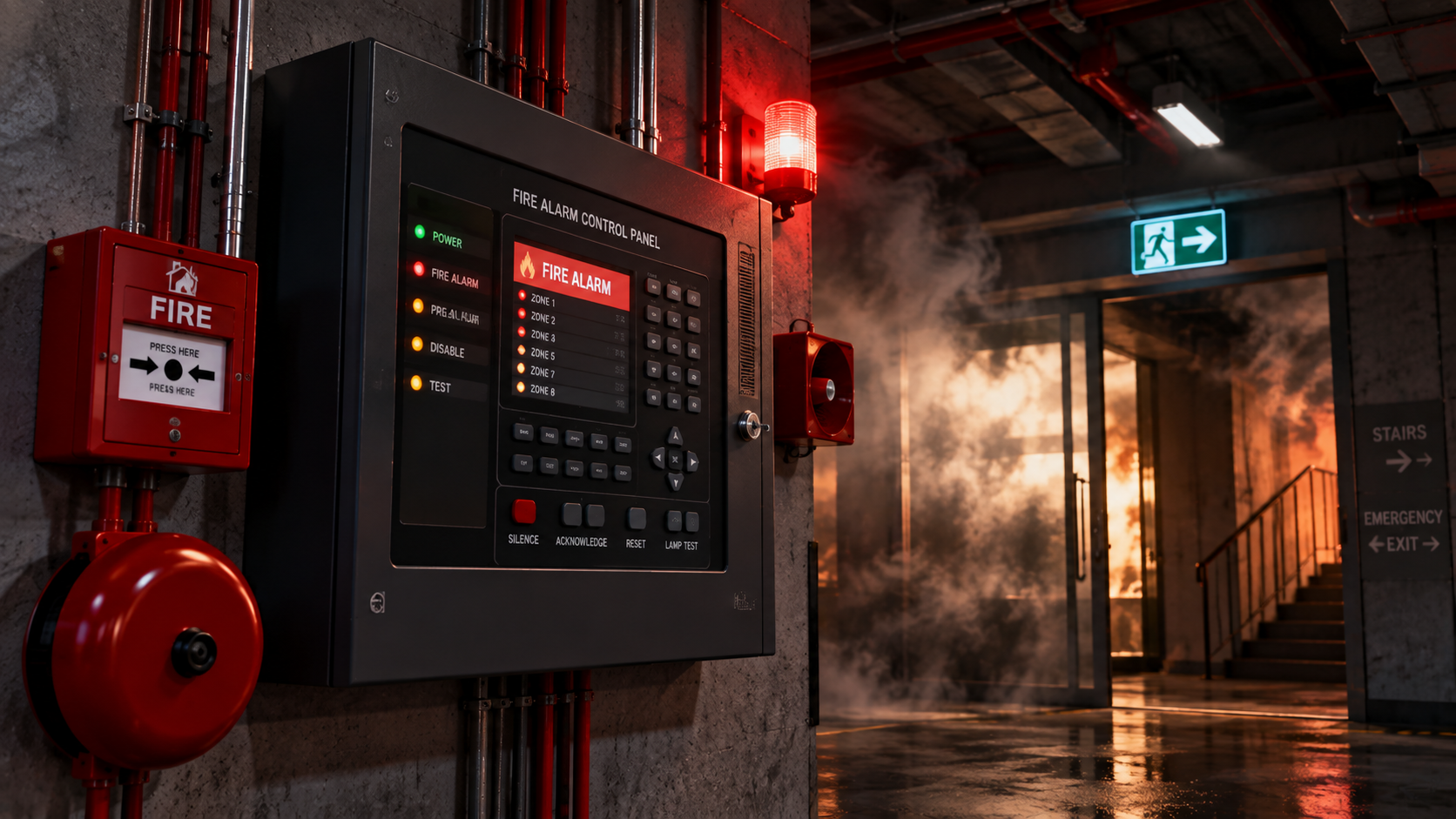
A fire alarm system control panel is the point where information from a building’s fire detection devices is received, interpreted, displayed, and turned into action. Smoke detectors, heat detectors, manual call points, sprinkler monitoring devices, notification appliances, and other connected equipment may all depend on the panel to coordinate the correct response.
That is why the panel is often described as the brain of the fire alarm system. The National Fire Protection Association’s guide to fire alarm basics describes the Fire Alarm Control Unit, or FACU, as the component that monitors inputs and controls outputs. It can identify alarm, supervisory, and trouble conditions and can initiate actions throughout the building.
For commercial and industrial facilities, understanding how the panel works is important because selecting the wrong architecture, installing it incorrectly, or overlooking maintenance can affect the performance of the entire fire detection system.
What Is a Fire Alarm System Control Panel?
A fire alarm system control panel is the central control unit responsible for receiving signals from connected devices and determining what the system should do next.
A smoke detector, for example, does not normally manage the building response by itself. It sends information to the control panel. Depending on the system design, the panel may then activate horns, speakers, strobes, send signals to a supervising station, display the location of the alarm, or activate connected emergency control functions.
The NFPA 72 National Fire Alarm and Signaling Code covers the design, installation, inspection, testing, and maintenance framework for fire alarm and signaling systems. Its structure makes clear that the control unit works within a much wider network of initiating devices, pathways, notification appliances, emergency control interfaces, and monitoring functions.
Why Is the Fire Alarm Control Panel Called the Brain of the System?
The description is useful because almost every important signal passes through or is processed by control equipment. NFPA describes a control unit as a component that monitors inputs and controls outputs.
This means that a fire alarm control panel must distinguish between different types of events rather than simply turning an alarm on or off. A detector activation, a closed sprinkler valve, and a broken circuit can all represent different conditions requiring different responses.
For building operators, that distinction is essential. The panel is not simply an alarm switch; it is an information and control platform for the building’s fire protection strategy.
Alarm, Supervisory, and Trouble Signals Are Not the Same
An alarm condition indicates a potential fire or other event requiring the programmed alarm response. A supervisory condition usually indicates that another monitored fire protection system or process requires attention, such as a sprinkler control valve being in an abnormal position.
A trouble condition indicates a fault within the system itself, such as a wiring problem or loss of a required power source. The NFPA fire alarm basics guidance specifically distinguishes these conditions because each communicates different information to the people responsible for the building.
Recognising these differences is one reason effective fire alarm monitoring depends on trained personnel rather than simply checking whether a green “normal” light is visible.
How Does a Fire Alarm System Control Panel Work?
The process begins when an initiating device detects or reports a condition. That initiating device might be a smoke detector, heat detector, manual call point, sprinkler waterflow switch, or another approved device.
The signal travels through the system pathway to the fire alarm control unit. The panel interprets the input according to its programming and system configuration, identifies the relevant condition, and initiates the required outputs.
Those outputs may include audible alarms, visual strobes, voice evacuation messages, transmission to a supervising station, or interfaces with other building systems.
What Happens After a Smoke Detector Activates?
In a basic scenario, a detector senses smoke and communicates an alarm condition to the panel. The panel processes that signal and activates the programmed building response.
However, a modern commercial fire alarm system may do much more. Depending on the approved design, the panel can interface with elevator recall, smoke-control equipment, fire doors, suppression systems, or other emergency functions. NFPA’s fire alarm system diagram specifically shows emergency control outputs including elevators, smoke control, and fire-door functions.
That is why panel programming must reflect the approved cause-and-effect sequence for the building. A technically functional panel with incorrect programming can still produce an incorrect system response.
What Is the Difference Between Addressable and Conventional Fire Alarm Panels?
One of the most important decisions in fire alarm design is whether the project will use conventional or addressable system architecture.
Both types can form part of a compliant fire alarm solution when appropriately designed, but they communicate device information differently. The right choice depends on the size, complexity, operational needs, future expansion requirements, and applicable project standards.
How Does a Conventional Fire Alarm Panel Work?
A conventional fire alarm panel typically groups initiating devices into zones. When a device within a zone activates, the panel identifies the affected zone rather than necessarily identifying the exact individual detector.
For a small facility, this may provide adequate information. A panel might indicate, for example, that an alarm originated from a particular floor, corridor, or defined section of the building.
The limitation becomes more noticeable as a building grows. If dozens of detectors share one conventional zone, locating the exact initiating device may require additional investigation after the alarm appears at the panel.
How Does an Addressable Fire Alarm Panel Work?
An addressable fire alarm panel communicates with individually identifiable devices through a signaling line circuit. Each compatible device has an identity within the system, allowing the panel to provide more specific information about where a signal originated.
This can significantly improve operational visibility in hotels, hospitals, industrial facilities, warehouses, towers, campuses, and other complex buildings where identifying a single device quickly matters.
Addressable architecture can also support more sophisticated programming and system diagnostics, although those capabilities increase the importance of correct design, configuration, documentation, and maintenance.
Addressable Does Not Automatically Mean Better for Every Project
The more advanced option is not automatically the correct option. System architecture must match the building’s requirements.
A small project may not benefit from unnecessary complexity, while a large facility may find conventional zoning too limited for efficient response and maintenance. The decision should therefore be made during fire alarm design rather than based purely on equipment price.
What Standards Apply to Fire Alarm Control Panels?
Control equipment used for life-safety applications must be suitable and approved for its intended purpose. In the United States and many specification-driven international projects, UL 864 is a major standard associated with control units and accessories for fire alarm systems.
UL explains that equipment evaluated under UL 864 undergoes performance and reliability testing, review of installation and programming instructions, construction assessment, product marking review, and safety testing. That provides an important distinction between listed life-safety equipment and general-purpose electronic control hardware.
For workplace fire detection systems, OSHA requirements also require detection devices and equipment to be approved for their intended purpose and maintained in operable condition.
What Applies to Fire Alarm Systems in Saudi Arabia?
In Saudi Arabia, project requirements must be evaluated against the applicable Saudi Building Code and the requirements of the authority having jurisdiction. The Saudi Fire Protection Code SBC 801 forms a central part of the regulatory framework for building fire protection.
This means fire alarm panel installation should never begin with the panel model alone. Designers must first establish the building requirements, system functions, detector coverage, notification strategy, interfaces, power requirements, and approval conditions.
Dar Al Hmaya’s fire and safety system services cover supply, installation, operation, inspection, and maintenance of fire alarm and firefighting systems, reflecting the fact that the control panel is only one component within the wider protection system.
Why Does Panel Selection Matter in Commercial Buildings?
The panel determines how much information operators receive and how effectively the system can coordinate connected devices. A small office and a large hospital do not necessarily need the same system capacity, networking architecture, number of loops, interfaces, or expansion capability.
A properly selected commercial fire alarm system should therefore consider the current building as well as realistic future requirements. Adding floors, changing occupancy, expanding a warehouse, or connecting additional fire protection equipment can affect panel capacity and architecture.
Choosing only for the immediate number of detectors can create limitations later.
The Control Panel Is Only as Effective as the System Around It
A fire alarm system control panel can receive signals, identify conditions, control outputs, and help coordinate emergency functions, but it cannot compensate for poor detector placement, unsuitable devices, incorrect wiring, weak documentation, or improper programming.
The panel therefore needs to be understood as the centre of a complete fire detection and signaling network. Its effectiveness depends on the quality of every input, pathway, output, power source, interface, and programmed response connected to it.
That leads to the next practical question: what components connect to the fire alarm control panel, and how does the panel communicate with detectors, manual call points, notification appliances, sprinkler systems, elevators, and other building systems?
What Connects to a Fire Alarm System Control Panel?
A fire alarm system control panel becomes useful only when it is connected to the devices that detect conditions, communicate warnings, and trigger emergency actions. These components form a network in which information travels from field devices to the panel and then back out to the systems that need to respond.
In a modern fire detection system, these connections may include smoke and heat detectors, manual call points, sprinkler monitoring devices, horns, strobes, speakers, remote annunciators, monitoring equipment, and interfaces with other building systems.
The exact configuration depends on the building, applicable codes, occupancy type, and approved fire strategy.
How Do Smoke and Heat Detectors Communicate With the Panel?
Smoke and heat detectors act as initiating devices. Their purpose is to detect a condition and send information to the fire alarm control unit, which then determines how the system should respond.
In a conventional system, detectors are generally grouped by zone. In an addressable system, each compatible device can communicate its own identity and status to the panel, giving operators more detailed information about where the event originated.
This is one reason an addressable fire alarm panel can be valuable in large or complex properties. The ability to identify a specific detector can reduce the time needed to investigate alarms, faults, or maintenance issues.
Detector Communication Is More Than an Alarm Signal
Depending on the technology, an addressable device may communicate more than a simple alarm or normal condition. The system may also identify trouble conditions, device faults, contamination warnings, or other diagnostic information supported by the manufacturer.
This additional visibility can support fire alarm panel maintenance, because technicians can use panel information to locate specific devices requiring inspection rather than searching across an entire zone.
The value, however, depends on correct programming and accurate device labels. A panel displaying the wrong room name or incorrect device description can create confusion at the exact moment when clear information matters most.
How Do Manual Call Points Connect to the Control Panel?
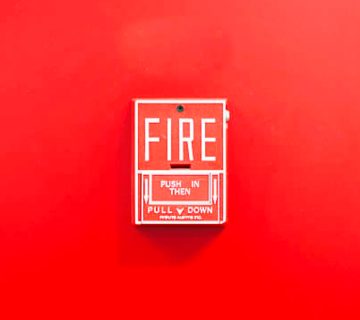
Manual call points allow building occupants to initiate a fire alarm manually after discovering a fire or dangerous condition. When operated, the device communicates with the panel, which then begins the programmed alarm sequence.
Their role is different from automatic detectors because they rely on human action rather than sensing smoke or heat. Both methods can exist within the same commercial fire alarm system, giving the building more than one way to initiate an emergency response.
The location, installation, and operation of these devices should follow the applicable code and approved system design rather than being treated as standalone equipment.
Why Must Manual and Automatic Signals Be Clearly Identified?
The control panel should provide enough information for responsible personnel to understand where the signal originated and, where required, what type of initiating device was involved.
In an addressable system, this may mean identifying a specific manual call point by floor and location. In a conventional system, the panel may indicate the zone containing the activated device.
Clear identification supports faster investigation and helps make the fire alarm monitoring process more useful to building staff and emergency responders.
How Does the Panel Activate Horns, Strobes, and Speakers?
Once the panel confirms an alarm condition, it can activate notification appliances designed to warn building occupants. These may include audible horns, bells, visual strobes, or emergency voice communication systems.
The NFPA guidance on fire alarm systems identifies notification appliances as a major part of the overall system, working alongside initiating devices and the control unit.
The panel coordinates when and where these devices operate according to the approved system design.
Voice Evacuation Systems Add Another Layer of Control
In some buildings, especially larger or more complex occupancies, simple horns may not be sufficient. Emergency voice systems can provide recorded or live instructions to occupants.
The fire alarm system control panel or associated voice control equipment may determine which zones receive particular messages based on the fire location and evacuation strategy.
This becomes especially important where phased evacuation is used rather than sounding the same instruction across an entire building at once.
How Does the Fire Alarm Panel Work With Sprinkler Systems?
A fire alarm panel does not control every part of a sprinkler system, but it can monitor important sprinkler-related conditions and respond when certain devices operate.
Waterflow switches, for example, can send an alarm signal when water begins moving through part of the sprinkler system. Valve supervisory switches can indicate when a monitored control valve is no longer in its normal position.
This allows the fire alarm control panel to become an important information point for multiple fire protection systems rather than working only with smoke detectors.
Supervisory Signals Need a Different Response
A closed or partially closed sprinkler valve does not necessarily indicate an active fire, but it can reduce the readiness of the sprinkler system. That is why such a condition is typically treated differently from a fire alarm.
The panel must distinguish between alarm, supervisory, and trouble signals so that responsible personnel receive the correct information and response.
This is one of the most important operational advantages of a properly designed fire alarm system: different problems produce different signals rather than being presented as the same generic warning.
How Can the Panel Control Other Building Systems?
Fire alarm systems often interface with building equipment that must respond during a fire. The exact functions depend on the approved fire strategy and applicable requirements.
The NFPA fire alarm basics material identifies emergency control functions such as elevator recall, smoke control, and fire-door operation as examples of outputs that may be connected to fire alarm control equipment.
A fire alarm system control panel may therefore provide signals that initiate predefined actions in other systems once specific fire conditions are detected.
Elevator Recall Is One Example of System Integration
In certain building designs, fire alarm signals can initiate elevator recall so that elevators respond according to the approved emergency sequence rather than continuing normal operation.
The panel does not simply “turn elevators off.” Instead, the interface follows a defined sequence based on detector locations, recall floors, system conditions, and the applicable design requirements.
That distinction illustrates why interfaces should be designed and tested by qualified specialists rather than added informally during installation.
Smoke Control Requires Precise Cause-and-Effect Programming
A panel may also communicate with smoke-control equipment, including fans and dampers, where required by the building design.
In these applications, the relationship between the fire detection system and mechanical equipment becomes more complex. A signal from one location may need to start one fan, stop another, open specific dampers, and close others.
This makes accurate cause-and-effect documentation essential.
What Is Fire Alarm Monitoring?
Fire alarm monitoring refers to the transmission and supervision of system signals beyond the local control panel, typically to an approved supervising station or other permitted receiving arrangement.
The purpose is to make sure important conditions are not visible only to someone standing in front of the panel. Depending on the system and regulatory requirements, alarm, supervisory, and trouble signals may be transmitted for further action.
The communication method must be appropriate for the approved system and maintained so that a loss of communication can itself be detected where required.
Monitoring Does Not Replace On-Site System Management
Remote monitoring can improve response, but it does not eliminate the need for trained building personnel, accurate documentation, or regular inspection.
If the panel shows recurring trouble conditions or poorly labelled devices, transmitting those signals elsewhere does not solve the underlying issue.
Effective monitoring therefore depends on a well-maintained fire alarm control unit and a clear process for responding to each type of signal.
What Is a Remote Annunciator?
A remote annunciator displays selected information from the main fire alarm panel at another location in the building. This can be useful where emergency responders or facility personnel need system information without travelling directly to the main equipment room.
An annunciator may show alarm zones, device locations, trouble conditions, or other information supported by the system design.
It does not necessarily replace the main control panel. Instead, it provides another point for viewing and, in some designs, limited authorised control.
Why Is Backup Power Important for the Control Panel?
A fire alarm system cannot depend entirely on normal building power because an electrical failure may occur before or during an emergency.
For this reason, fire alarm systems typically include secondary power arrangements designed according to applicable standards. The control panel supervises power conditions and can indicate when the normal or secondary supply has a problem.
The OSHA requirements for employee alarm systems and fire detection systems also emphasise that fire detection equipment must remain maintained in operable condition.
Battery Condition Is Part of System Reliability
Backup batteries are not accessories that can be installed and forgotten. Their condition, capacity, terminals, charging system, and replacement requirements form part of ongoing fire alarm panel maintenance.
A panel may continue to appear normal on mains power even when its backup capacity has deteriorated. Proper testing is therefore necessary to confirm that the secondary supply can perform as required.
Why Does Accurate Programming Matter?
In an addressable system, programming connects a device’s electronic identity to a meaningful physical location and response. A detector might technically communicate correctly while being labelled as the wrong room or linked to the wrong output sequence.
This creates a serious operational problem. During an alarm, personnel could be directed toward the wrong area or the panel could initiate inappropriate control functions.
Correct programming, therefore, is just as important as correct fire alarm panel installation.
Documentation Must Match the Installed System
Device lists, zone charts, cause-and-effect matrices, drawings, and panel labels should reflect the system that actually exists in the building.
If changes are made during construction but the documentation is not updated, future maintenance teams may work from inaccurate information.
That is why commissioning and handover documentation form an important bridge between installation and long-term operation.
System Integration Turns the Panel Into a Control Centre
A fire alarm system control panel receives information from detectors, manual call points, sprinkler monitoring devices, and other initiating equipment. It then coordinates notification appliances, monitoring signals, and approved emergency control functions.
The more systems connected to the panel, the more important correct design, programming, labelling, power supervision, and documentation become. The panel is not valuable simply because it contains advanced electronics; its value comes from coordinating the building’s fire response correctly.
That raises the final practical issue: how should a fire alarm control panel be installed, tested, inspected, and maintained so that it remains reliable throughout the life of the building?
How Should a Fire Alarm System Control Panel Be Installed?
Once the devices, interfaces, and cause-and-effect functions have been defined, the reliability of the fire alarm system control panel depends heavily on installation quality. The panel must be installed in accordance with the approved design, applicable codes, product listing, and manufacturer instructions.
Installation is not simply a matter of mounting the cabinet and connecting cables. Power supplies, circuit supervision, device addressing, communication pathways, grounding, labeling, interfaces, and programming all affect how the completed fire alarm system performs.
The current NFPA 72 National Fire Alarm and Signaling Code addresses installation alongside inspection, testing, maintenance, initiating devices, emergency control interfaces, and supervising-station systems.
Where Should the Fire Alarm Control Panel Be Located?
Panel location should support safe access, inspection, operation, and emergency response while meeting the applicable project requirements. The exact position depends on the building design and requirements of the authority having jurisdiction.
A panel hidden behind equipment or installed where access regularly becomes obstructed can create operational problems later. Facility teams and authorised technicians need practical access for investigation, testing, resetting, maintenance, and troubleshooting.
In larger projects, remote annunciators may also be provided so system information is available at another strategic location without moving the primary fire alarm control unit.
Why Does Clear Circuit and Device Labeling Matter?
Good labeling connects what appears on the screen to what physically exists inside the building. Device descriptions, circuit references, zone names, floor information, and interface labels should be meaningful to the people expected to use the system.
For an addressable fire alarm panel, a description such as “Detector 037” offers far less operational value than a verified location that identifies the actual area served.
Poor labeling becomes particularly problematic during maintenance or an alarm investigation, because technicians may spend valuable time confirming which physical device corresponds to the panel indication.
What Happens During Fire Alarm System Commissioning?
Commissioning verifies that the installed system matches the approved design and performs its intended functions. It is the stage where drawings, programming, devices, interfaces, notification equipment, and power arrangements are checked against actual system behaviour.
OSHA guidance notes that fire detection systems should be designed by knowledgeable professionals and that an acceptance test should be performed after installation to confirm proper operation. Its fire protection guidance reinforces the importance of testing the completed system rather than assuming installation alone proves reliability.
How Is a Fire Alarm Control Panel Tested?
Testing should confirm that inputs reach the panel correctly and that the programmed outputs occur as intended. A detector alarm, manual call point activation, sprinkler waterflow condition, supervisory event, or system fault should produce the appropriate indication and response.
The system also needs to be returned to normal operating condition after testing. OSHA fire detection requirements specifically require systems and components to be restored promptly following a test or alarm.
This matters because a successful test is not complete if a device, circuit, or control function remains isolated afterward.
Cause-and-Effect Testing Is Critical
Where the panel controls other building functions, the test should extend beyond audible alarms and strobes. If a detector is programmed to initiate elevator recall, close fire doors, or activate smoke-control functions, those outputs need to be verified as part of the approved sequence.
This is especially important in sophisticated commercial fire alarm system installations, where one alarm input may initiate several coordinated actions.
What Are Common Fire Alarm Control Panel Faults?
A trouble indication does not necessarily mean the entire system has failed, but it should never be treated as background noise. The panel is designed to report abnormal conditions precisely so they can be investigated.
Problems may originate from communication pathways, field wiring, device removal, battery condition, power supplies, network connections, ground faults, or other supervised system components.
Repeatedly acknowledging a trouble condition without addressing its cause weakens the value of fire alarm monitoring and can allow a genuine system problem to remain unresolved.
Why Are Ground Faults and Wiring Problems Important?
A supervised fire alarm system is designed to identify certain pathway abnormalities. Wiring damage, loose connections, moisture, or installation changes can therefore appear as panel trouble conditions.
The correct response is not simply to reset the panel repeatedly. A trained technician needs to identify the affected circuit, determine the cause, correct it, and confirm that the system has returned to normal.
This is where accurate drawings and previous maintenance records become particularly valuable.
What Does a Battery Trouble Signal Mean?
The panel’s secondary power supply is essential to system reliability. A battery-related trouble signal may indicate a problem with battery capacity, charging, connection, or another part of the secondary power arrangement.
Ignoring the warning because normal mains power is still available can create a hidden weakness. If normal power later fails, the system may not have the backup capability expected by the design.
Why Is Fire Alarm Panel Maintenance Necessary?
Fire alarm panel maintenance protects more than the electronics inside the cabinet. The control panel sits at the centre of a network, so ongoing maintenance should consider connected devices, circuits, power supplies, communication links, interfaces, and system programming.
NFPA 72 dedicates Chapter 14 to inspection, testing, and maintenance, reflecting the importance of maintaining the system after commissioning rather than treating acceptance as the end of the process.
OSHA likewise requires covered fire detection systems to remain operable except during repair or maintenance and requires servicing, maintenance, and testing to be performed by trained personnel knowledgeable about the system.
Maintenance Should Follow the Actual System Configuration
There is no value in using a generic maintenance routine that ignores the equipment installed in the building. An addressable networked system serving several buildings has different operational considerations from a small conventional fire alarm panel.
The maintenance plan should consider manufacturer instructions, applicable standards, system records, previous faults, environmental conditions, and any changes made to the building.
If additional rooms, walls, equipment, or occupancies have been introduced, the fire detection arrangement may also require review.
Software and Programming Changes Must Be Controlled
Modern panels may rely extensively on configuration data and cause-and-effect programming. An undocumented software change can therefore affect system behaviour even when no physical wiring has changed.
Any authorised modification should be recorded, verified, and reflected in the current system documentation. Previous versions should also be managed carefully where required by the maintenance process.
For facilities teams, configuration control is increasingly becoming part of maintaining the fire alarm control unit, not a separate IT concern.
When Should a Fire Alarm Control Panel Be Upgraded or Replaced?
A control panel does not need replacement simply because a newer model exists. The decision should instead consider system reliability, equipment support, spare-part availability, expansion requirements, compatibility, recurring faults, and the building’s current fire strategy.
An older panel that remains compliant, maintainable, supported, and suitable for the facility may continue to perform its intended function. Conversely, a panel that cannot support required expansion or whose replacement components are no longer practically available may create growing operational risk.
Building Changes Can Outgrow the Existing Panel
A facility may add new floors, expand a warehouse, change room layouts, introduce new fire-protection interfaces, or require more detailed monitoring.
In these situations, the original panel capacity, circuit architecture, or programming capability may no longer suit the building. An upgrade can then become part of a wider fire-system review rather than a simple equipment replacement.
An addressable fire alarm panel may offer practical benefits in a complex expansion, but the decision still needs to come from engineering requirements rather than technology preference alone.
What Should Saudi Facilities Consider?
For projects in Saudi Arabia, fire alarm panel installation and system modification should be assessed against the applicable Saudi codes and authority requirements.
The Saudi Fire Protection Code SBC 801 contains the national fire-protection framework relevant to building fire alarm and safety systems. Project teams should also consider the building classification, approved drawings, equipment requirements, and applicable authority approvals.
Dar Al Hmaya provides fire alarm and firefighting system services covering supply, installation, inspection, operation, and maintenance, helping facilities treat the control panel as part of the complete fire-protection system rather than as isolated equipment.
Why Are Maintenance Records So Important?
A service record shows how the system has behaved over time. Repeated battery failures, communication faults, intermittent devices, or recurring circuit troubles can reveal patterns that a single inspection may not show.
Good records also help future technicians understand what was changed, which components were replaced, what tests were completed, and whether previous faults returned.
This continuity becomes increasingly important as facilities change contractors, technicians, or internal maintenance personnel.
Fire Alarm System Control Panel: Final Takeaway
A fire alarm system control panel is much more than the box that displays an alarm. It receives information from detectors and other initiating devices, distinguishes between alarm, supervisory, and trouble conditions, controls notification appliances, communicates with monitoring systems, and can coordinate approved emergency functions throughout a building.
Its reliability depends on the complete system around it. Correct fire alarm panel installation, accurate programming, clear documentation, reliable primary and secondary power, functional field devices, appropriate interfaces, commissioning, and ongoing fire alarm panel maintenance all contribute to whether the system performs as expected.
For commercial buildings, the best panel is therefore not automatically the panel with the greatest number of features. It is the fire alarm control panel that matches the approved fire strategy, building complexity, regulatory requirements, operational needs, and future capacity of the facility.
Facilities planning a new fire alarm system, panel replacement, expansion, or maintenance programme can review Dar Al Hmaya’s fire and safety services or contact the team through the Dar Al Hmaya contact page to discuss the requirements of the building and its existing fire protection systems.