

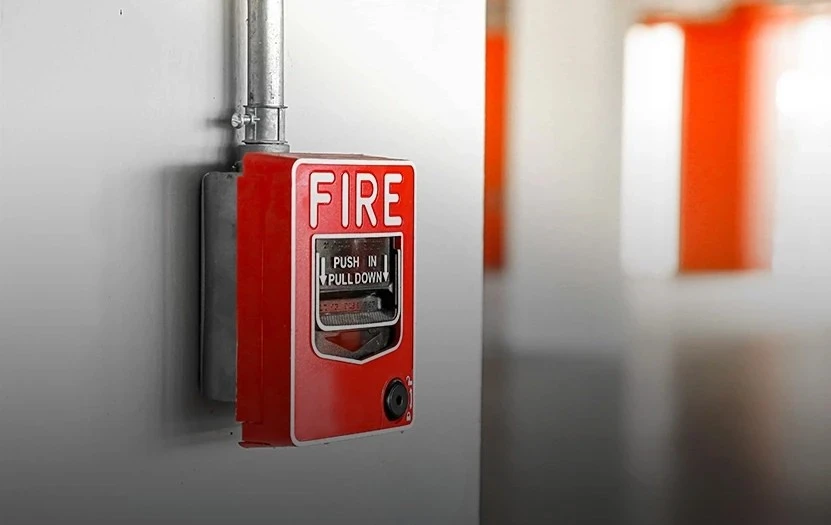
A Practical Overview of Fire Alarm System Types in Modern Buildings
Fire safety is no longer a secondary consideration in today’s built environment. As cities expand vertically and horizontally, especially across Saudi Arabia’s fast-growing urban centres, the role of reliable fire alarm systems has become central to overall building fire safety. This is where understanding the types of fire alarm systems stops being a technical topic and becomes a strategic decision that affects lives, assets, and regulatory compliance.
From the perspective of DARS, fire alarm systems are not just devices installed to tick a regulatory box. They are integrated fire detection systems designed to respond early, communicate clearly, and support safe evacuation when seconds matter.
Why Understanding Fire Alarm System Types Matters
Choosing the right fire alarm system is not about selecting the most advanced option by default. It is about suitability. A system that performs perfectly in a high-rise commercial tower may be unnecessary or inefficient in a small retail space. Conversely, under-specifying a system in a complex facility can expose occupants to risk and operators to serious liability.
Fire alarm systems act as the first active line of defence in any fire strategy. They detect threats early through smoke and heat detectors, process signals through a fire alarm control panel, and trigger emergency notification systems that guide occupants toward safety. Each of these steps must work seamlessly, and the system type determines how accurately and reliably this happens.
This becomes even more critical in markets governed by strict regulations. In Saudi Arabia, fire alarm installation standards are closely aligned with international frameworks such as NFPA 72, adapted to local Saudi Civil Defense requirements. Selecting the correct system type supports compliance, reduces false alarms, and simplifies approval processes for commercial fire alarm systems.
How Fire Alarm Systems Work at a High Level
Before comparing system types, it helps to understand the shared foundation. Regardless of complexity, all fire alarm systems follow the same functional logic.
Detection devices monitor the environment for signs of fire, such as smoke particles, rapid temperature changes, or visible flames. These signals are transmitted to the fire alarm control panel, which evaluates the input and determines whether to activate alarms, interface with other safety systems, or notify monitoring services. When confirmed, the system initiates audible and visual alerts through emergency notification systems, supporting evacuation and emergency response.
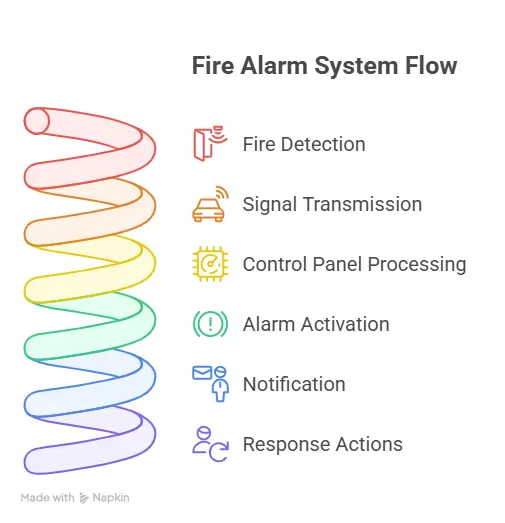
This shared logic is executed differently depending on the system architecture, which leads directly into the main types of fire alarm systems used today.
Conventional Fire Alarm Systems Explained
What Defines a Conventional Fire Alarm System
A conventional fire alarm system is one of the most widely used and well-established system types. It operates by dividing a building into zones, with multiple detectors connected to each zone circuit. When a device activates, the fire alarm control panel identifies the affected zone rather than the exact device.
This approach offers simplicity and reliability. It has fewer components, straightforward wiring, and lower upfront costs compared to more advanced systems. For this reason, conventional systems remain popular in smaller buildings where pinpoint accuracy is not critical.
Where Conventional Systems Work Best
In practice, conventional systems are well suited to villas, small offices, clinics, and retail units. These environments typically have limited floor areas, predictable layouts, and lower occupancy loads. When an alarm triggers, responders can quickly locate the affected zone without operational confusion.
From a regulatory standpoint, conventional systems can meet Saudi Civil Defense requirements when applied correctly and designed according to approved standards. However, their limitations become more apparent as building complexity increases.
Key Strengths and Trade-offs
The main advantage of a conventional fire alarm system lies in its cost-effectiveness and ease of maintenance. Installation is relatively fast, and fault diagnosis is simple because circuits are clearly defined.
The trade-off is reduced precision. If a zone covers multiple rooms or large areas, identifying the exact fire source may take longer. In larger or multi-storey buildings, this delay can have serious implications, which is why other system types are often recommended for complex sites.
Addressable Fire Alarm Systems and Why They Dominate Large Projects
Understanding Addressable Architecture
An addressable fire alarm system assigns a unique digital address to every device connected to the system. Instead of identifying zones only, the fire alarm control panel can pinpoint the exact detector or manual call point that initiated the alarm.
This architectural shift transforms how fire events are managed. Operators receive precise information instantly, allowing for faster verification and targeted response. In large facilities, this level of detail is not a luxury. It is a necessity.
Why Addressable Systems Are Preferred in Complex Buildings
High-rise towers, hospitals, factories, airports, and mixed-use developments benefit significantly from addressable systems. These environments often include thousands of devices spread across multiple floors and zones. Without addressability, alarm management becomes inefficient and error-prone.
Addressable systems also integrate more easily with building management systems. They can interface with elevators, access control, smoke extraction, and suppression systems, supporting coordinated emergency response strategies.
Operational and Compliance Advantages
From a compliance perspective, addressable fire alarm systems align well with modern fire alarm installation standards. They support detailed event logging, system diagnostics, and advanced testing procedures, all of which simplify inspections and audits.
They also reduce false alarms by allowing smarter programming and sensitivity adjustments. This is especially important in commercial fire alarm systems where unnecessary evacuations can disrupt operations and erode trust in safety protocols.
The Role of Detection Devices in System Performance
Smoke and Heat Detectors as the Front Line
Regardless of system type, detection devices determine how early a fire is identified. Smoke and heat detectors are selected based on the specific risk profile of each area. For example, smoke detectors are ideal for offices and accommodation spaces, while heat detectors perform better in kitchens or industrial areas where airborne particles are common.
The effectiveness of a fire detection system depends on correct detector selection, spacing, and calibration. A sophisticated control panel cannot compensate for poor detector design.
Integration with Control and Notification Systems
Detectors communicate continuously with the fire alarm control panel, transmitting both alarm and fault signals. In addressable systems, this communication includes status data that helps maintenance teams identify issues before they escalate.
When alarms are confirmed, emergency notification systems take over. These may include sounders, voice evacuation messages, and visual alarms designed to support occupants with hearing or visual impairments.
This layered approach is essential for comprehensive building fire safety, especially in high-occupancy or public buildings.
Fire Alarm Systems in the Context of Saudi Arabia’s Built Environment
Saudi Arabia’s construction landscape is evolving rapidly under Vision 2030 initiatives. Mega-projects, smart cities, and infrastructure expansion place increasing demands on fire safety systems. In this context, understanding the types of fire alarm systems is not just technical knowledge. It is a strategic capability.
DARS approaches fire alarm solutions as part of an integrated safety framework, aligned with Saudi Civil Defense approvals and international best practices. System selection considers building use, occupancy, operational risk, and long-term maintainability, not just initial cost.
Advanced Architectures and Smart Adaptations
As buildings become more complex and operational demands increase, traditional wired systems are not always the most practical solution. This is where advanced fire alarm system types come into play. Wireless, two-wire, analog, and intelligent systems are designed to address modern challenges such as retrofitting, scalability, and data-driven decision-making, while still meeting strict fire alarm installation standards.
From DARS’s perspective, these systems are not alternatives for the sake of innovation. They are targeted solutions developed to solve real-world constraints in construction, expansion, and long-term operation.
Wireless Fire Alarm Systems and Retrofit Scenarios
Why Wireless Systems Exist
Wireless fire alarm systems eliminate the need for extensive cabling by using secure radio communication between devices and the fire alarm control panel. This architecture is especially valuable in buildings where installing new wiring is disruptive, expensive, or structurally impractical.
Historic buildings, operational hospitals, and occupied commercial facilities often fall into this category. Shutting down areas to install cables may not be feasible, making wireless systems a practical path to compliance and improved building fire safety.
Reliability and Regulatory Considerations
Modern wireless fire detection systems are engineered with redundancy, encrypted communication, and continuous signal supervision. Battery performance is closely monitored, and panels receive alerts well before power levels become critical.
From a compliance standpoint, wireless systems can meet Saudi Civil Defense requirements when properly designed and approved. The key is not the absence of wires, but the presence of reliable, monitored communication and certified components.
Where Wireless Systems Perform Best
Wireless solutions are often used in phased projects, temporary structures, or sites expecting future layout changes. Their flexibility allows devices to be relocated or expanded with minimal disruption, which aligns well with fast-moving commercial environments and adaptive reuse projects.
Two-Wire Fire Alarm Systems and Installation Efficiency
Simplifying Without Sacrificing Control
Two-wire fire alarm systems combine power and communication on a single circuit. This approach reduces cabling requirements while maintaining many of the benefits associated with addressable systems.
For expanding developments or mid-sized commercial buildings, two-wire systems strike a balance between simplicity and performance. Installation times are reduced, material costs are controlled, and system architecture remains scalable.
Practical Use in Growing Developments
In rapidly developing areas, where timelines and coordination between trades are tight, two-wire systems offer logistical advantages. They allow contractors to deploy fire detection systems efficiently without compromising on core functionality.
DARS often evaluates two-wire systems in projects where future expansion is anticipated, but full-scale intelligent systems may not yet be justified. This staged approach supports both immediate compliance and long-term planning.
Analog Fire Alarm Systems and Environmental Sensitivity
Moving Beyond Binary Detection
Analog fire alarm systems continuously measure environmental data rather than relying solely on fixed alarm thresholds. Detectors send variable signals to the control panel, which interprets trends and patterns to determine whether a genuine fire condition exists.
This approach significantly improves accuracy in environments where smoke, dust, or heat fluctuations are common. Instead of triggering alarms prematurely, the system analyses change over time.
Reducing False Alarms in Critical Facilities
False alarms are more than an inconvenience. In hospitals, data centres, and industrial plants, they disrupt operations and can erode confidence in safety systems. Analog systems help address this by distinguishing between normal environmental variations and true fire indicators.
By integrating smoke and heat detectors with advanced signal processing, these systems contribute to more stable and reliable fire detection systems, particularly in sensitive or high-value environments.
Intelligent Fire Alarm Systems and Predictive Capabilities
What Makes a System Intelligent
Intelligent fire alarm systems build on addressable and analog foundations by incorporating software-driven logic, adaptive algorithms, and advanced diagnostics. These systems do not simply react. They learn, adapt, and optimise performance over time.
Through continuous data analysis, intelligent systems can adjust detector sensitivity, identify maintenance needs, and anticipate potential faults. This shifts fire safety from a reactive model to a proactive one.
Integration with Broader Safety Ecosystems
In modern buildings, fire alarm systems rarely operate in isolation. Intelligent systems integrate seamlessly with emergency notification systems, access control, HVAC, and building management platforms. This coordination enables automated responses such as controlled evacuation sequencing or smoke management activation.
Such integration is increasingly expected in large commercial fire alarm systems, especially those supporting mixed-use developments or critical infrastructure.
Strategic Value Beyond Compliance
While intelligent systems meet regulatory requirements, their real value lies in operational insight. Facility managers gain visibility into system health, usage patterns, and response history. This data supports informed decision-making and long-term risk management.
DARS views intelligent fire alarm systems as part of a broader safety and resilience strategy, not just a compliance tool.
Manual and Automatic Detection Working Together
Understanding the Difference in Activation
Manual detection relies on human intervention through call points, while automatic detection uses sensors to identify fire conditions without human input. Both play distinct roles within a comprehensive fire alarm system.
Automatic detection provides early warning, especially outside working hours or in low-visibility areas. Manual activation adds redundancy, allowing occupants to raise alarms when they perceive danger before sensors respond.
Balanced System Design in Practice
In many commercial and public buildings, combining both approaches delivers the most robust outcome. Automatic detectors ensure rapid response, while manual points empower occupants to act immediately.
This layered design philosophy aligns with best practices in building fire safety and is often emphasised in Saudi Civil Defense guidelines for high-occupancy facilities.
System Selection as a Risk-Based Decision
Choosing among the various types of fire alarm systems is ultimately a risk-based exercise. Building size, occupancy profile, operational continuity, and regulatory expectations all influence the decision.
A small office may function effectively with a conventional system, while a logistics hub or hospital demands addressable or intelligent architectures. Wireless and two-wire options fill specific gaps where installation constraints or future flexibility are priorities.
DARS approaches system selection through structured risk assessment, ensuring that each solution matches both present needs and future realities. This philosophy is reflected across projects showcased in the projects section and reinforced through ongoing advisory support.
Preparing for Ongoing Monitoring and Maintenance
No fire alarm system, regardless of sophistication, remains effective without proper monitoring and maintenance. Fire alarm monitoring services ensure that alarms, faults, and supervisory signals are responded to even when buildings are unoccupied.
Advanced systems simplify this process through remote diagnostics and automated reporting. This reduces downtime, supports compliance audits, and enhances long-term system reliability.
As systems become smarter, maintenance shifts from reactive fixes to planned interventions, improving both safety outcomes and operational efficiency.
Selection, Compliance, and Long-Term Performance
The final step in understanding the types of fire alarm systems is knowing how to apply that knowledge in real projects. System selection is not theoretical. It is shaped by regulations, building use, operational risk, and the long-term responsibility of keeping people and assets safe. This is where technical understanding must translate into practical decisions.
From DARS’s experience, the most successful fire alarm systems are those chosen with clarity, approved with confidence, and maintained with discipline.
How to Select the Right Fire Alarm System for a Building
Matching System Type to Building Function
Every building tells a different risk story. Residential properties prioritise early detection and clear evacuation signals, while industrial facilities focus on reliability in harsh environments. Commercial towers require precise location data and system integration to manage large occupant numbers efficiently.
This is why selecting between a conventional fire alarm system and an addressable fire alarm system is never arbitrary. Smaller sites may benefit from simplicity, but larger or more complex buildings demand accuracy, scalability, and integration with other safety systems.
The goal is alignment. The system must align with how the building is used today and how it may evolve tomorrow.
Understanding Occupancy and Risk Profiles
Occupancy type directly affects system requirements. Hospitals, schools, malls, and factories each carry different fire risks and evacuation challenges. Smoke and heat detectors must be selected and distributed accordingly, ensuring early detection without unnecessary false alarms.
Risk assessment plays a central role here. It connects building design, human behaviour, and fire detection systems into a single safety strategy. Without this step, even advanced systems can fall short.
Regulatory Compliance in Saudi Arabia
Saudi Civil Defense and Approval Pathways
In Saudi Arabia, fire alarm systems must meet Saudi Civil Defense requirements, which draw heavily from international standards such as NFPA 72. Compliance is not limited to equipment choice. It extends to system design, installation practices, testing procedures, and documentation.
Approval processes evaluate whether the system supports effective detection, notification, and evacuation under realistic conditions. This is why fire alarm installation standards are treated as a complete framework rather than a checklist.
DARS works within these frameworks to ensure systems are not only approved but also practical to operate and maintain over time. More details on regulatory alignment can be found in DARS’s Civil Defense classification overview.
The Role of Certified Contractors
Even the best-designed system can fail if installed incorrectly. Certified contractors understand local regulations, authority expectations, and technical nuances that affect approval and performance.
They also act as a bridge between designers, authorities, and building owners. This coordination reduces delays, avoids costly redesigns, and ensures that systems function as intended from day one.
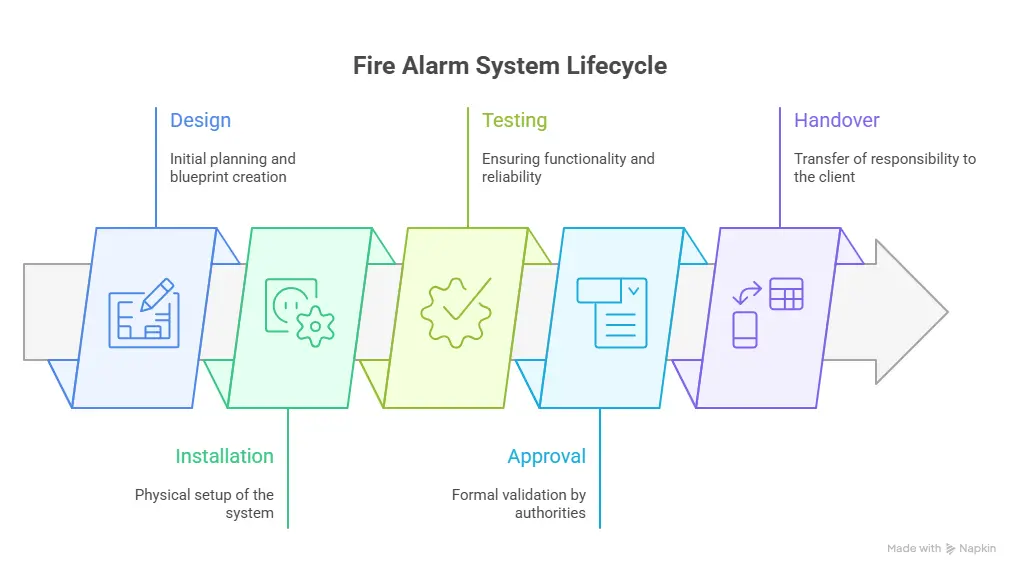
Installation Quality and System Integrity
Why Installation Is as Important as Design
Fire alarm systems are highly sensitive networks. Cable routing, device spacing, panel configuration, and programming all influence system reliability. Poor installation practices can introduce faults that compromise detection accuracy or delay alarm activation.
Quality installation ensures that fire detection systems operate consistently across all conditions. It also simplifies future testing and troubleshooting, which directly impacts operational confidence.
Commissioning and Testing as Critical Milestones
Commissioning verifies that every device communicates correctly with the fire alarm control panel and that emergency notification systems activate as required. This phase is not a formality. It is a validation of the entire safety strategy.
Proper testing also creates a performance baseline, allowing future inspections to identify deviations early. This is essential for maintaining compliance and readiness.
Long-Term Maintenance and Monitoring
Why Fire Alarm Systems Require Ongoing Attention
Fire alarm systems are not install-and-forget solutions. Environmental conditions, building modifications, and component aging all affect performance over time. Without maintenance, even advanced systems lose reliability.
Fire alarm monitoring services add another layer of protection by ensuring alarms and faults are addressed even when buildings are unoccupied. This is especially critical for commercial fire alarm systems operating around the clock.
From Reactive Fixes to Proactive Management
Modern systems support proactive maintenance through diagnostics, alerts, and performance reporting. Intelligent and addressable systems, in particular, enable maintenance teams to identify issues before they escalate.
This shift reduces downtime, improves safety outcomes, and supports long-term cost control. It also strengthens regulatory compliance by ensuring systems remain inspection-ready at all times.
Information on DARS’s approach to lifecycle safety management is available through the risk management services page.
Common Mistakes in Fire Alarm System Selection
One of the most common mistakes is choosing systems based solely on initial cost. While budget considerations matter, under-specifying a system often leads to higher costs later through upgrades, false alarms, or compliance issues.
Another frequent issue is ignoring future expansion. Buildings rarely remain static, and systems that cannot scale create operational bottlenecks. Selecting adaptable architectures early reduces disruption and protects long-term investment.
Finally, treating fire alarm systems as isolated components rather than part of a broader safety ecosystem limits their effectiveness. Integration with emergency notification systems, suppression, and building management platforms maximises value and safety.
Fire Alarm Systems as a Strategic Asset
When viewed correctly, fire alarm systems are not just safety equipment. They are strategic assets that protect people, preserve continuity, and demonstrate regulatory responsibility.
In fast-developing markets, particularly across Saudi Arabia’s commercial and industrial sectors, well-designed fire detection systems support confidence among occupants, investors, and authorities alike.
DARS positions fire alarm solutions within this broader perspective, combining technical expertise with regulatory insight and operational understanding. This approach is reflected across its projects portfolio and ongoing client partnerships.
Final Thoughts
Understanding the types of fire alarm systems is the foundation of effective fire safety planning. Conventional, addressable, wireless, analog, and intelligent systems each serve a purpose when applied correctly.